


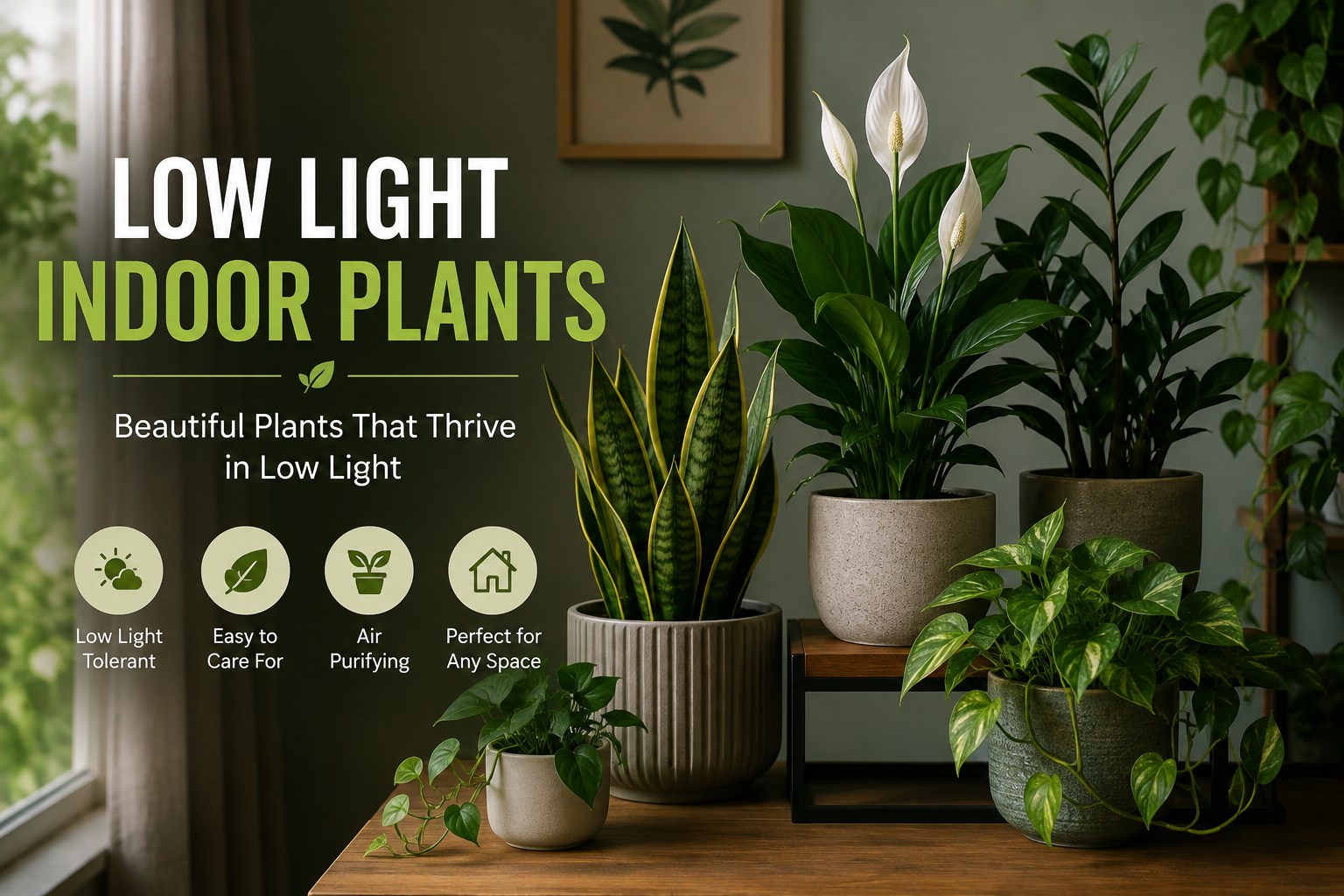
Not every home has bright windows or hours of direct sunshine. Fortunately, low light indoor plants can bring greenery into bedrooms, offices, hallways, bathrooms, and other spaces where sunlight is limited. The key is choosing plants that can tolerate weaker light without expecting them to grow as quickly as they would in brighter conditions.
The best low light indoor plants are not plants that need no light at all. They are species that can adapt to lower levels of natural light and still maintain healthy foliage when their basic care needs are met. Snake plants, ZZ plants, cast iron plants, pothos, Chinese evergreen, and several other hardy houseplants are popular choices.
Whether you need very low light indoor plants, a small plant for a shelf, or large greenery for a dim living room, the right choice depends on your available light, watering habits, space, and plant-care experience.
What Does Low Light Mean for Indoor Plants?
Low light usually means an area receives limited indirect daylight rather than complete darkness. A room with a north-facing window, a plant positioned several feet from a brighter window, or a hallway with some reflected daylight may all provide lower-light conditions.
It’s important to remember that low light indoor plants still need light for photosynthesis. A completely windowless room may require supplemental lighting if you want a plant to remain healthy for an extended period.
One of the biggest mistakes beginners make is assuming that a plant labeled “low light” will thrive anywhere. In reality, some plants merely tolerate low light, while others perform better under these conditions.
Low Light vs. No Light
Low light and no light are not the same thing.
| Light Condition | Typical Situation | Suitable Approach |
| Bright indirect light | Near a bright window | Most houseplants |
| Medium light | Several feet from a window | Many foliage plants |
| Low light | Dim corner or north-facing room | Shade-tolerant plants |
| Very low light | Extremely limited daylight | Hardy plants plus supplemental light |
| No natural light | Windowless room | Grow light recommended |
This distinction is especially important when choosing low light indoor plants for offices, basements, and interior rooms.
How Can You Tell If Your Room Has Low Light?
Before buying a plant, look at the actual conditions in the room rather than relying only on the room’s name.
A north-facing window may provide relatively soft light, while curtains, nearby buildings, trees, and the distance between the plant and window can reduce available light even further.
You can also use a simple shadow test. Place your hand near the area where you want the plant. A very faint shadow suggests lower light, while a strong, clearly defined shadow usually indicates more intense light.
Consider the Distance From the Window
The same room can contain several different light zones. A plant sitting directly beside a window receives much more light than one positioned across the room.
For example, imagine an office with one window. A pothos on the windowsill may receive moderate indirect light, while a ZZ plant on a desk several feet away may experience much lower light.
This is why low light indoor plants should be selected according to their actual placement.
20 Best Low Light Indoor Plants
There are many excellent options, but the following low light indoor plants stand out for different reasons.
1. Snake Plant
Snake plants are among the easiest choices for beginners. Their upright leaves look attractive in modern interiors, and they generally cope well with lower light and periods between watering.
They are particularly useful for people who tend to overwater because they prefer their growing medium to dry between waterings.
2. ZZ Plant
The ZZ plant is another excellent choice for lower-light rooms. It has glossy foliage and a naturally tidy appearance, making it suitable for offices, bedrooms, and living rooms.
Among low light indoor plants, it is especially appealing to busy plant owners because it does not require constant attention.
3. Cast Iron Plant
As its name suggests, the cast iron plant has a reputation for toughness. It can handle lower light better than many decorative houseplants and is useful for dim hallways or corners.
It is also a good option when you want foliage without committing to a high-maintenance plant.
4. Chinese Evergreen
Chinese evergreen offers attractive patterned foliage and works well in homes and offices. It is one of the more decorative low light indoor plants for people who want visual interest without needing intense sunlight.
Keep watering moderate and avoid leaving the roots sitting in soggy soil.
5. Pothos
Pothos is especially useful for shelves, cabinets, and hanging baskets. Its trailing stems can create a lush appearance even when positioned away from a bright window.
It is one of the most versatile low light indoor plants because it works in both small and large arrangements.
6. Heartleaf Philodendron
Heartleaf philodendron has attractive heart-shaped leaves and naturally trailing growth. It is a practical choice for shelves or hanging planters.
Give it enough indirect light to maintain healthy growth while avoiding prolonged exposure to harsh direct sunlight.
7. Peace Lily
Peace lilies are popular for their green foliage and white flowers. They can tolerate lower light, although flowering may be reduced when conditions become too dim.
If your main goal is flowers, give the plant brighter indirect light whenever possible.
8. Dracaena
Dracaena varieties can add height to a room without requiring a large amount of floor space. They are particularly useful when searching for large low light indoor plants for living rooms or offices.
Avoid keeping the soil constantly wet, especially when the plant is growing slowly in lower light.
9. Parlor Palm
Parlor palms offer a softer, tropical appearance and can work well in rooms with indirect light. They are useful when you want a larger plant that doesn’t have the rigid shape of a snake plant.
10. Kentia Palm
Kentia palms can become substantial indoor plants and make a strong statement in larger rooms. They are better suited to spaces that have some ambient daylight rather than completely dark corners.
11. Spider Plant
Spider plants are compact, adaptable, and easy to display in hanging baskets. They can be useful for beginners who want an attractive plant without complicated maintenance.
12. Dieffenbachia
Dieffenbachia has large decorative leaves that can make a noticeable impact indoors. It can tolerate lower light but usually benefits from brighter indirect conditions for stronger growth.
13. Arrowhead Plant
Arrowhead plants can develop attractive trailing or climbing growth. They are a good option for shelves and plant stands where you want foliage to spill over the edge.
14. English Ivy
English ivy can be grown indoors in suitable conditions and works especially well as a trailing plant. Keep it in a location with enough indirect light and avoid consistently saturated soil.
15. Lady Palm
Lady palms offer upright, elegant foliage and can work as floor plants in larger interiors. They are a useful choice when you want something more substantial than a tabletop plant.
16. Peperomia
Peperomias are excellent for small spaces. Their compact size makes them suitable for desks, shelves, and side tables.
They are a strong option when searching for small low light indoor plants, although they still need enough indirect light to maintain healthy growth.
17. Prayer Plant
Prayer plants are known for decorative foliage and distinctive leaf patterns. They can tolerate lower indirect light but often require more attention to moisture and humidity than very hardy options such as ZZ plants.
18. Calathea
Calatheas are valued for their patterned leaves and tropical appearance. They can be attractive low light indoor plants, but they generally require more consistent care than beginner favorites.
Avoid allowing the soil to become excessively dry or constantly waterlogged.
19. Corn Plant
Corn plants can provide vertical greenery in living rooms and offices. They are useful when you want large low light indoor plants without selecting a particularly wide plant.
20. Lucky Bamboo
Lucky bamboo can work well in smaller interiors and is often displayed in decorative containers. It is an appealing option for desks, shelves, and compact rooms where a full-sized floor plant would be impractical.
Low Light Indoor Plants Compared
The best plant depends on what you want from it. Use this table as a quick starting point.
| Plant | Light Tolerance | Water Needs | Size | Best Use | Beginner-Friendly |
| Snake Plant | Excellent | Low | Medium–Tall | Bedrooms, offices | Yes |
| ZZ Plant | Excellent | Low | Medium | Offices, corners | Yes |
| Cast Iron Plant | Excellent | Moderate | Medium | Hallways | Yes |
| Pothos | Very good | Moderate | Trailing | Shelves | Yes |
| Chinese Evergreen | Very good | Moderate | Medium | Living rooms | Yes |
| Peace Lily | Good | Moderate | Medium | Bathrooms | Fairly |
| Dracaena | Good | Moderate | Tall | Living rooms | Yes |
| Peperomia | Good | Low–Moderate | Small | Desks | Yes |
| Calathea | Moderate | Moderate | Small–Medium | Decorative displays | No |
Best Low Light Plants for Different Rooms
Low Light Indoor Plants for Bedrooms
Bedrooms often benefit from compact, easy-care plants. Snake plants, ZZ plants, and small Chinese evergreen varieties can work well when positioned where they receive some indirect daylight.
Choose plants based on the room’s actual light rather than assuming every bedroom is low light.
Low Light Indoor Plants for Bathrooms
Bathrooms can be suitable for certain shade-tolerant plants when they have a window or another source of usable light. Peace lilies, pothos, and cast iron plants may work in appropriate conditions.
Remember that humidity does not replace light.
Low Light Indoor Plants for Offices
Offices are ideal places for hardy options because people often forget regular watering. ZZ plants, snake plants, pothos, and Chinese evergreen can be practical choices.
If your office has no window, consider adding a grow light.
Low Light Indoor Plants for Living Rooms
Large rooms give you more opportunities to use tall plants. Dracaena, kentia palm, and parlor palm can add height, while pothos works well on shelves.
For larger spaces, low light indoor plants can create greenery without taking over the room.
Small Low Light Indoor Plants
For desks and shelves, consider peperomia, compact snake plant varieties, small Chinese evergreen, or suitable arrowhead plants.
Small plants are especially useful in apartments, dorm rooms, and compact offices.
Large Low Light Indoor Plants
If you want a statement plant, consider dracaena, kentia palm, parlor palm, or corn plant. Make sure the room provides enough ambient daylight for long-term health.
How to Care for Low Light Indoor Plants
Lower light changes how quickly a plant uses water. A plant receiving less light may grow more slowly and dry out more slowly, so watering according to a fixed weekly schedule can lead to problems.
Before watering, check the soil and consider the specific plant’s moisture requirements.
Use Well-Draining Soil
A container with drainage holes helps prevent excess water from accumulating around the roots. This is particularly important for low light indoor plants because slow growth can mean slower water consumption.
Avoid Overfertilizing
Plants growing slowly generally do not need excessive fertilizer. Follow the requirements of the individual species and avoid assuming more fertilizer will compensate for poor lighting.
Clean and Rotate the Leaves
Dust can build up on leaves over time. Gently cleaning foliage can improve its appearance. Rotating a plant occasionally can also encourage more even growth when light comes primarily from one direction.
Signs Your Plant Is Not Getting Enough Light
Watch for changes rather than waiting until the plant is seriously struggling.
| Symptom | Possible Cause | What to Do |
| Leggy growth | Too little light | Move closer to a light source |
| Pale foliage | Insufficient light | Increase indirect light |
| Very slow growth | Low light | Improve placement |
| Leaning toward window | Uneven light | Rotate or reposition |
| Yellow leaves | Watering/root issue possible | Check soil moisture |
| Loss of variegation | Insufficient light | Provide brighter indirect light |
Remember that yellow leaves do not automatically mean a plant needs more sunlight. Overwatering, root problems, aging leaves, and other issues can create similar symptoms.
Do Low Light Plants Need Grow Lights?
Some low light indoor plants can survive comfortably with natural indirect daylight. However, a grow light becomes useful when a room receives almost no natural light.
Windowless offices, interior bathrooms, basements, and very dark corners are common examples.
A grow light should supplement the available light rather than being treated as a replacement for appropriate plant care. Follow the manufacturer’s recommendations for positioning and operating time because light intensity varies between fixtures.
Low Light: Tolerate vs. Thrive
This distinction is important when comparing low light indoor plants.
A plant that tolerates low light may remain alive but produce slower growth, smaller leaves, or less attractive foliage.
A plant that performs well in lower light is more likely to maintain healthy growth when the rest of its care is appropriate.
Therefore, don’t choose a plant simply because a label says “low light.” Consider how much light your specific location actually provides.
Common Mistakes With Low Light Plants
Avoid these common problems:
- Assuming low light means complete darkness.
- Watering every plant on the same schedule.
- Placing plants too far from windows.
- Choosing only by appearance.
- Using containers without drainage.
- Expecting fast growth in dim conditions.
- Overfertilizing slow-growing plants.
- Ignoring signs of root problems.
- Forgetting that different species have different needs.
- Assuming every low-light plant has identical tolerance.
These simple mistakes can make even hardy low light indoor plants struggle.
How to Choose the Right Plant
Start with your room rather than the plant.
If you forget to water, choose a drought-tolerant option such as a snake plant or ZZ plant. If you need something for a shelf, choose pothos or another trailing variety. If you want height, consider dracaena or a suitable palm.
For pet owners, check reliable species-specific toxicity information before purchasing. Don’t assume that every houseplant with similar care requirements is automatically safe.
The best low light indoor plants are ultimately the ones that match both your environment and your care habits.
Conclusion
Choosing low light indoor plants becomes much easier when you first understand the light available in your room. Low light does not mean no light, and even the toughest houseplant needs enough illumination to remain healthy.
For beginners, snake plants and ZZ plants are excellent starting points. Pothos and heartleaf philodendron are useful for shelves, while dracaena and palms can add height to larger rooms. Small plants such as peperomia can brighten desks and compact spaces.
The most important rule is simple: match the plant to the environment. Check the light, avoid overwatering, use well-draining containers, and consider a grow light when natural illumination is extremely limited. With the right match, low light indoor plants can add attractive, long-lasting greenery to spaces that might otherwise feel bare.
Frequently Asked Questions
What are the best low light indoor plants for beginners?
Snake plants, ZZ plants, cast iron plants, pothos, and Chinese evergreen are practical choices for beginners. They can handle lower-light conditions better than many demanding tropical plants.
Can plants survive in very low light?
Some low light indoor plants can survive in very dim areas, but extremely low light can result in slow growth and weak foliage. If natural light is almost absent, supplemental lighting is usually a better solution.
What are the best small low light indoor plants?
Peperomia, compact snake plants, small Chinese evergreen varieties, and suitable arrowhead plants can work well on desks and shelves.
What are the best large low light indoor plants?
Dracaena, corn plants, kentia palms, and parlor palms can provide height in larger rooms, provided they receive enough ambient light.
How often should I water low light indoor plants?
There is no universal watering schedule. Lower light can slow growth and drying, so check the soil and follow the moisture requirements of each species rather than watering automatically every week.
Can low light indoor plants live in a windowless room?
They may survive temporarily in extremely limited light, but long-term growth generally requires some usable light. A suitable grow light can provide supplemental illumination in a windowless space.
Are low light indoor plants good for bedrooms?
Yes. Many hardy varieties can work well in bedrooms when the room provides suitable indirect light. Choose according to available space, humidity, and your watering habits.
You May Also Read: diy crafts with paper
