
Choosing the best flowers for gardens is about more than picking the prettiest blooms at the garden center. The right flowers should match your sunlight, soil, climate, available space, watering routine, and the amount of care you want to provide.
Some gardeners want colorful flowers that bloom for months, while others need low-maintenance plants that can handle heat and dry conditions. You may also want best Flowers for Gardens that attract bees and butterflies, work well in containers, or complement vegetables in a productive garden.
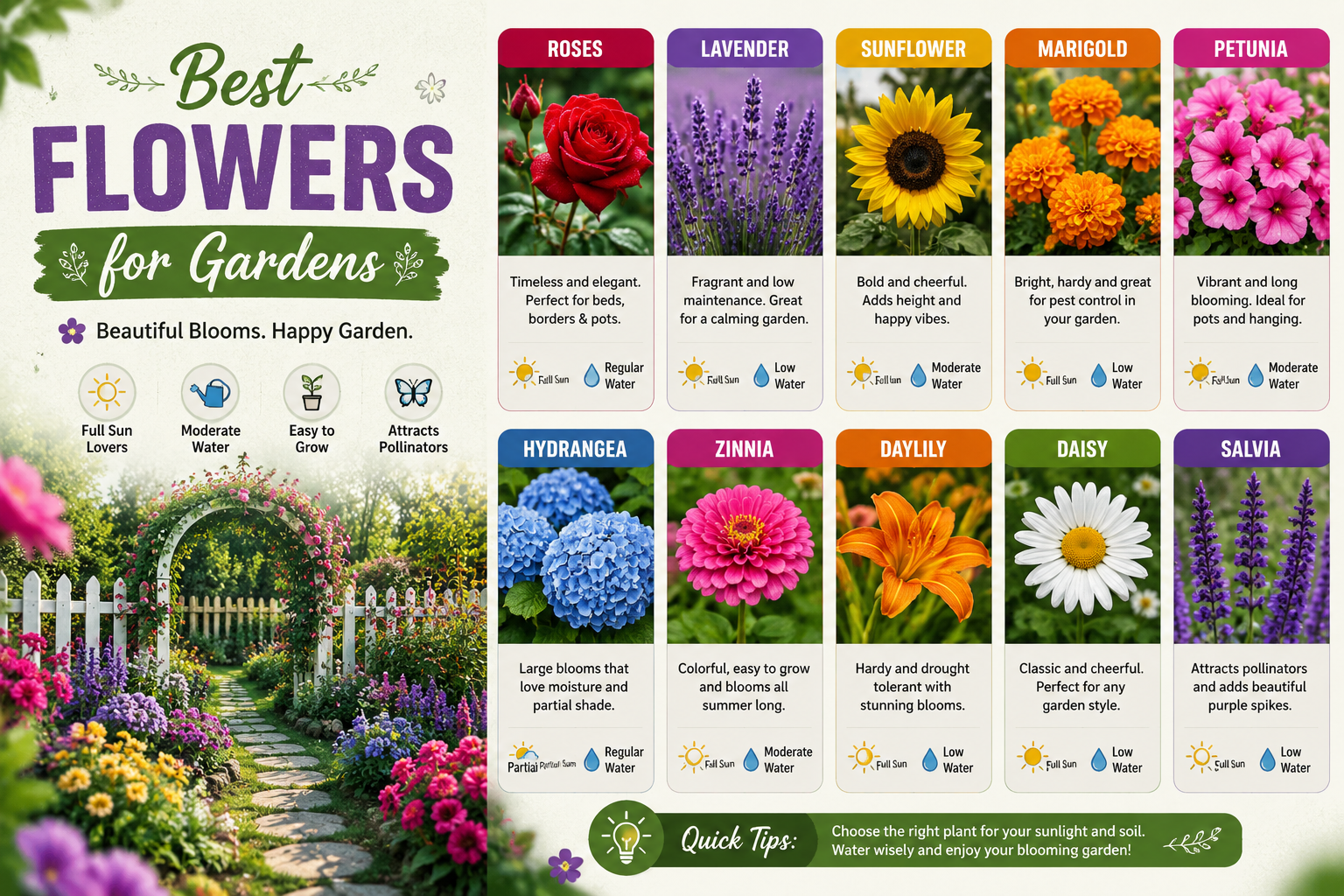
The good news is that there are plenty of best flowers for gardens for almost every growing situation. From cheerful zinnias and marigolds to long-lived coneflowers and fragrant lavender, you can build a beautiful garden by choosing plants that fit your conditions.
Best Flowers for Gardens at a Glance
Before choosing individual plants, this quick comparison makes it easier to find the best flowers for gardens based on your needs.
| Flower | Type | Sunlight | Water Needs | Bloom Season | Best For |
| Zinnia | Annual | Full sun | Moderate | Summer–Fall | Beginners |
| Coneflower | Perennial | Full sun | Low–Moderate | Summer–Fall | Pollinators |
| Marigold | Annual | Full sun | Moderate | Summer–Fall | Vegetable gardens |
| Sunflower | Annual | Full sun | Moderate | Summer | Height and color |
| Lavender | Perennial | Full sun | Low | Summer | Dry gardens |
| Cosmos | Annual | Full sun | Low–Moderate | Summer–Fall | Easy growing |
| Salvia | Annual/Perennial | Sun | Low–Moderate | Summer–Fall | Pollinators |
| Pansy | Annual/Biennial | Part shade–Sun | Moderate | Cool seasons | Containers |
| Black-eyed Susan | Perennial | Full sun | Low–Moderate | Summer–Fall | Low maintenance |
| Petunia | Annual | Full sun | Moderate | Spring–Fall | Pots and borders |
This table shows why the best flowers for gardens vary depending on your growing conditions. There is no single flower that is perfect for every location.
25 Best Flowers for Gardens
1. Zinnias
Zinnias are among the best flowers for gardens if you want bright colors and an easy growing experience. They thrive in full sun and produce flowers in shades such as pink, red, orange, yellow, white, and purple.
They are especially useful for beginners because they grow quickly and provide a long season of color. Zinnias also make excellent cut flowers and attract butterflies.
2. Coneflowers
Coneflowers, especially purple coneflower, are reliable perennial choices. Their daisy-like blooms and raised centers add texture to flower beds while attracting bees and butterflies.
Once established, many coneflowers tolerate periods of dry weather. That makes them some of the best flowers for gardens where gardeners want attractive plants without constant watering.
3. Marigolds
Marigolds are colorful, compact, and easy to grow. Their yellow and orange flowers work beautifully around vegetable beds, borders, and containers.
If you are looking for flowers to plant in vegetable garden to deter pests, marigolds are a popular choice. However, they should not be treated as a guaranteed pest-control solution. Their greatest benefits are their flowers, easy care, and ability to attract beneficial insects.
4. Sunflowers
Sunflowers are among the most recognizable best flowers for gardens. Their tall stems create a dramatic background, while dwarf varieties can fit smaller spaces.
Plant them in a sunny location with enough room for mature growth. Their seeds can also provide food for birds after flowering.
5. Black-Eyed Susans
Black-eyed Susans produce golden-yellow flowers with dark centers and are excellent for natural-looking borders.
They tolerate a range of conditions once established and provide late-season interest. Their durability makes them some of the best flowers for gardens for gardeners who prefer dependable perennials.
6. Cosmos
Cosmos produce delicate, daisy-like flowers on slender stems. They are excellent choices for informal gardens and are generally easy to grow from seed.
They prefer plenty of sunlight and can continue flowering through much of the growing season when conditions are favorable.
7. Lavender
Lavender combines flowers, fragrance, and attractive foliage. It prefers full sun and well-drained soil and generally dislikes constantly wet conditions.
For gardeners with dry, sunny spaces, lavender can be one of the best flowers for gardens because its water needs are relatively modest once established.
8. Salvia
Salvia provides upright flower spikes that add height and structure to beds. Many types are highly attractive to bees, butterflies, and other pollinators.
Choose a variety appropriate for your climate because salvia species differ in hardiness and growing requirements.
9. Petunias
Petunias are versatile annuals that work particularly well in containers, hanging baskets, and garden borders.
They come in numerous colors and can provide abundant seasonal flowers with regular care. Their trailing growth also makes them useful for softening the edges of pots.
10. Dahlias
Dahlias are excellent when large, colorful flowers are a priority. Their blooms come in an impressive range of forms and colors.
They need suitable sunlight, regular moisture, and good soil to perform well. Taller varieties may also require support.
11. Snapdragons
Snapdragons bring vertical flower spikes to gardens and containers. They are particularly useful for adding height without relying entirely on very tall plants.
Depending on the climate, they can be especially valuable during cooler growing periods.
12. Pansies
Pansies are among the best flowers for gardens when you want color during cooler weather. Their cheerful faces work well in containers, borders, and small beds.
They generally prefer cooler conditions and can struggle during extreme heat.
13. Nasturtiums
Nasturtiums are attractive annuals with rounded foliage and bright flowers. Some varieties trail beautifully over containers or garden edges.
They are also edible, making them interesting additions to gardens where ornamental and productive planting overlap.
14. Coreopsis
Coreopsis produces cheerful daisy-like blooms and is valued for its long flowering period and relatively easy care.
It can be particularly useful in sunny borders and pollinator-friendly gardens.
15. Bee Balm
Bee balm provides colorful flowers and is a strong choice for pollinator gardens. Its tubular blooms can attract bees, butterflies, and hummingbirds.
Give it enough air circulation because some conditions can encourage fungal problems.
16. Sweet Alyssum
Sweet alyssum is a low-growing plant covered with small, fragrant flowers. It works particularly well along borders, pathways, and the edges of containers.
Its compact form makes it one of the best flowers for gardens where gardeners need a soft foreground layer.
17. Daylilies
Daylilies are hardy perennial plants that can tolerate a range of conditions. Their strap-like foliage adds structure even when the plants are not flowering.
Individual flowers may last only briefly, but established plants can produce numerous blooms.
18. Daffodils
Daffodils provide some of the earliest seasonal color in many gardens. They are grown from bulbs and can return year after year under suitable conditions.
Planting spring bulbs is an excellent way to create a garden that starts flowering before summer annuals reach their peak.
19. Asters
Asters are valuable for extending garden color into late summer and fall. Their daisy-like flowers can also provide important food for late-season pollinators.
Adding asters is a smart way to create more continuous bloom throughout the year.
20. Geraniums
Geraniums are popular for containers, window boxes, and sunny garden spaces. They offer long-lasting seasonal color when given appropriate conditions.
Their compact growth makes them useful when you want attractive flowers without taking up too much ground space.
21. Calendula
Calendula produces warm-colored flowers and is relatively easy to grow. It can work in ornamental gardens as well as spaces where edible flowers are desired.
Its cheerful blooms make it a useful addition to informal and cottage-style gardens.
22. Hydrangeas
Hydrangeas are popular for their large flower clusters and strong visual impact. They can become substantial shrubs, so they need more planning than small annuals.
Choose the species and variety carefully according to your climate, soil, moisture, and available space.
23. Roses
Roses remain classic garden plants because of their fragrance, colors, and variety of growth forms. They can work as shrubs, climbers, borders, or focal points.
Modern varieties vary considerably in disease resistance and maintenance requirements, so selecting an appropriate variety is important.
24. Peonies
Peonies are long-lived perennials valued for their large, fragrant blooms. Once established, they can become reliable garden features for many years.
Their relatively short bloom period makes them especially useful when combined with plants that flower before or after them.
25. Columbines
Columbines bring delicate, distinctive flowers to the garden and can be particularly useful in partial-shade locations.
Their unusual flower shape adds visual interest and works well in naturalistic and cottage-style planting.
How to Choose the Best Flowers for Your Garden
The best flowers for gardens are ultimately the ones that fit the conditions you already have.
Check Sunlight First
Start by observing your garden before buying plants. A full-sun area generally receives several hours of direct sunlight, while part-shade and shade locations receive less.
Zinnias, sunflowers, lavender, and many salvias prefer sunny conditions. Pansies, begonias, and some columbines can provide options where sunlight is limited.
Consider Your Soil
Healthy soil supports healthy roots, but different flowers have different preferences. Most plants need good drainage, while some tolerate heavier or more moisture-retentive soils.
Avoid assuming that adding large amounts of fertilizer will solve every soil problem. A simple soil test can provide more useful information about pH and nutrients.
Match Water Requirements
Grouping plants with similar water requirements makes garden maintenance easier.
For example, lavender and other drought-tolerant choices should not necessarily be planted beside flowers that require consistently moist soil. Matching plants by water needs is one of the simplest ways to create a healthier garden.
Consider Climate and Growing Zone
A flower that thrives in one region may struggle somewhere else. Check the recommended hardiness zone and local growing information before investing in perennial plants.
This is particularly important when choosing best perennial flowers for vegetable garden borders or permanent beds because perennials remain in place for multiple growing seasons.
Best Flowers for Full-Sun Flower Beds
If your flower bed receives plenty of direct sunlight, consider:
- Zinnias
- Sunflowers
- Marigolds
- Coneflowers
- Lavender
- Coreopsis
- Cosmos
- Black-eyed Susans
- Salvia
These are some of the best flowers for flower beds in full sun, but water and soil conditions still matter.
For a simple sunny bed, place taller sunflowers toward the back, medium-height zinnias and coneflowers in the middle, and shorter marigolds or sweet alyssum along the front.
Best Flowers for Shade and Part Shade
Not every garden receives bright sunlight all day. For shaded or partly shaded spaces, consider plants such as:
- Pansies
- Begonias
- Columbines
- Impatiens
- Coral bells
Before planting, determine whether the area receives morning sun, afternoon shade, dappled light, or deep shade. “Shade” can mean very different conditions.
Best Low-Maintenance Flowers
If you want a garden that does not demand constant attention, consider:
- Coneflowers
- Black-eyed Susans
- Coreopsis
- Lavender
- Marigolds
- Zinnias
- Salvia
Remember that low-maintenance does not mean maintenance-free. Newly planted flowers still need appropriate watering, and many plants benefit from occasional deadheading, pruning, or weed control.
Best Flowers for Bees and Butterflies
Flowers can make an ornamental garden more useful to local wildlife. Coneflowers, bee balm, zinnias, salvia, lavender, cosmos, asters, and sunflowers are all worth considering.
When planning flowers for garden pollination, think beyond a single plant. A better strategy is to provide flowers across different seasons so pollinators have access to resources for a longer period.
Avoid relying on one flower species alone. A diverse planting can provide different flower shapes, bloom periods, and resources for different insects.
Best Flowers for Vegetable Gardens
Flowers can also be integrated into productive gardens.
Marigolds, calendula, nasturtiums, zinnias, and sunflowers can add color while supporting beneficial insects and pollinators.
If you are researching best flowers for vegetable gardens, focus on flowers that fit without competing excessively with vegetables for light, water, and space.
For flowers to plant in vegetable garden to deter pests, marigolds are frequently suggested, but companion planting should not be viewed as a guaranteed substitute for monitoring, sanitation, physical barriers, or other appropriate pest-management practices.
Annual vs. Perennial Flowers
Both types have a place among the best flowers for gardens.
| Feature | Annuals | Perennials |
| Lifespan | Usually one season | Return for multiple years |
| Replanting | Usually needed | Usually not annual |
| Seasonal color | Excellent | Varies |
| Long-term structure | Lower | Higher |
| Examples | Zinnia, marigold, cosmos | Coneflower, daylily, peony |
Annuals are excellent for quick seasonal color, while perennials provide lasting structure. Combining both can create a more dynamic garden.
How to Create Flowers That Bloom Through the Seasons
A common mistake is choosing flowers that all bloom at the same time.
Instead, combine early-, mid-, and late-season plants.
Spring: Daffodils, pansies, columbines
Summer: Zinnias, lavender, coneflowers, sunflowers
Late summer and fall: Asters, black-eyed Susans, cosmos
This succession approach helps your garden stay interesting for longer and is one reason seasonal planning matters when selecting the best flowers for gardens.
How to Arrange Flowers in a Garden
Good placement can make even a small collection of plants look intentional.
Put taller flowers such as sunflowers toward the back of a border. Place medium-height plants such as zinnias and coneflowers in the center. Use low-growing plants such as sweet alyssum and marigolds along the edge.
Repeat a few flower colors instead of using a different color for every plant. Repetition creates visual rhythm and makes the garden feel more cohesive.
For a small garden, you can also combine upright, mounding, and trailing plants in containers to create layers without needing a large planting bed.
Should You Choose Native Flowers?
Native flowers can be excellent choices because they are adapted to local environmental conditions and can support regional wildlife.
However, “native” does not automatically mean every plant will thrive in every part of your garden. Sunlight, soil, drainage, moisture, and mature size still matter.
For the strongest results, combine locally appropriate native plants with other flowers that genuinely fit your growing conditions.
Common Mistakes When Choosing Garden Flowers
Even the best flowers for gardens can perform poorly when planted in the wrong location.
Avoid these common mistakes:
- Ignoring sunlight requirements
- Planting without checking mature size
- Overcrowding the flower bed
- Overwatering plants that prefer dry soil
- Choosing flowers unsuitable for your climate
- Planting everything at the same height
- Forgetting bloom succession
- Ignoring drainage
- Expecting low-maintenance plants to require zero care
- Choosing plants solely because they look attractive at the garden center
The goal is not to buy the most flowers. It is to create a combination where each plant has enough space and suitable conditions.
A Simple Flower Garden Plan for Beginners
If you are starting your first garden, keep it simple.
For a sunny 10-by-10-foot bed, you could place taller sunflowers toward the back, groups of zinnias and coneflowers through the middle, and marigolds and sweet alyssum around the edges.
This gives you height, color, different flower shapes, and a mix of annual and perennial plants.
You can adjust the selection according to your climate and available space. Starting with a manageable number of plants also makes it easier to learn how your soil, sunlight, and watering routine affect growth.
Conclusion
The best flowers for gardens are not necessarily the rarest or most expensive varieties. They are plants that match your garden’s sunlight, soil, climate, water availability, and maintenance level.
For beginners, easy choices such as zinnias, marigolds, cosmos, sunflowers, and coneflowers provide a strong starting point. If pollinators are a priority, add bee balm, salvia, asters, lavender, and other nectar- and pollen-rich flowers. For vegetable gardens, flowers can add beauty while supporting a more diverse growing space.
Start with a few reliable plants, give them the conditions they need, and observe how they perform. Over time, you can expand your garden with more of the best flowers for gardens that suit your particular space.
Frequently Asked Questions
What are the best flowers for gardens for beginners?
Zinnias, marigolds, cosmos, sunflowers, calendula, and coneflowers are good starting points because many varieties are relatively easy to grow. Always check local growing conditions before planting.
What are the best flowers for full sun?
Zinnias, sunflowers, lavender, coneflowers, marigolds, cosmos, coreopsis, and black-eyed Susans are popular choices for sunny locations.
What flowers attract bees and butterflies?
Coneflowers, bee balm, zinnias, salvia, cosmos, lavender, sunflowers, and asters can provide valuable floral resources for pollinators.
Are annual or perennial flowers better for a garden?
Neither is universally better. Annuals provide seasonal color and flexibility, while perennials return for multiple years and can form the foundation of a garden. A combination is often ideal.
What are the best flowers for vegetable gardens?
Marigolds, calendula, nasturtiums, zinnias, and sunflowers can work well around vegetable gardens when their mature size and water requirements are compatible with nearby crops.
Which flowers are easiest to grow from seed?
Zinnias, cosmos, marigolds, sunflowers, and nasturtiums are commonly grown from seed and can be good choices for gardeners who want to start plants without purchasing mature specimens.
How many flowers should I plant in my garden?
There is no universal number. Base the amount on mature plant size, spacing recommendations, garden dimensions, and the visual effect you want. Avoid overcrowding because poor airflow can increase plant problems.
You May Also Read: Flowers That Attract Bees
