


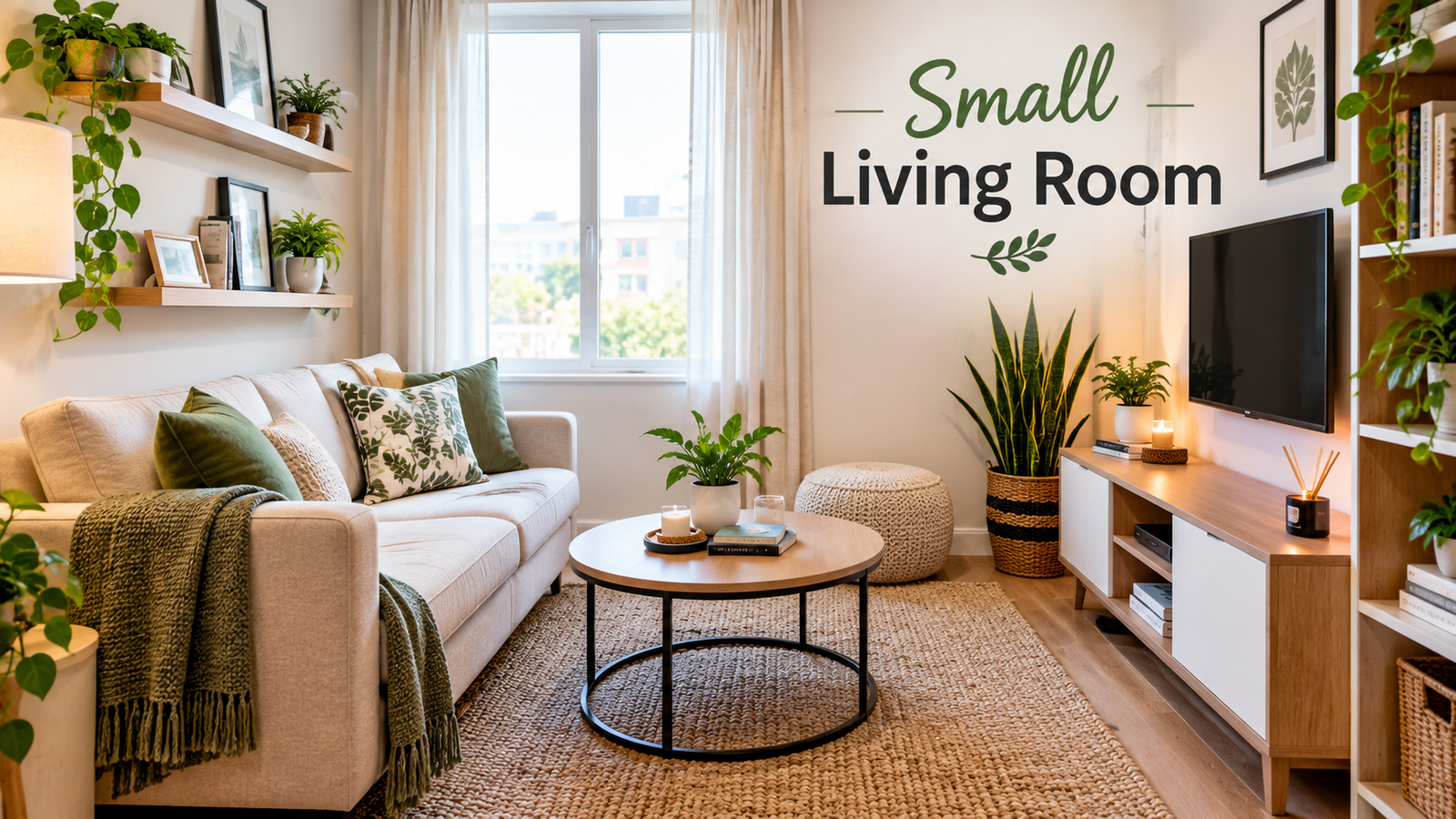
A small living room can be comfortable, stylish, and highly functional when every piece has a clear purpose. The key is not simply buying smaller furniture or removing everything from the room. Good small living room ideas focus on layout, proportion, storage, lighting, and the way people actually move through the space.
Before decorating, measure the room and note doors, windows, outlets, radiators, and the main walking route. Then decide whether the room is mainly for watching TV, relaxing, entertaining, reading, or a combination of activities. This simple planning step can prevent expensive furniture mistakes.
Whether you live in an apartment, rent a compact home, or simply have a tight family room, these small living room ideas can help you create a room that feels organized without sacrificing personality.
How to Plan a Small Living Room Before Decorating
The best small living room ideas start with the room itself rather than a shopping list. Measure each wall, including the usable floor area, and record the position of doors and windows. Don’t forget door swings because a piece of furniture that technically fits may still interfere with movement.
Next, identify the room’s main purpose. A TV-focused room needs a different arrangement from a conversation space or a room that also serves as a home office.
Create one obvious traffic route through the room. Current layout guidance commonly recommends prioritizing clear circulation and avoiding furniture that forces people to squeeze around corners.
Choose a Focal Point
The focal point could be a television, fireplace, large window, artwork, or architectural feature. Arrange the largest furniture around that feature instead of allowing several competing focal points.
Give Every Piece a Job
In a compact room, unnecessary furniture quickly becomes visual clutter. A storage ottoman can provide seating, a footrest, and hidden storage, while nesting tables can provide flexible surfaces without taking up permanent floor space.
Small Living Room Furniture Spacing Guide
Furniture scale is one of the most important parts of small living room ideas. A compact room does not necessarily require miniature furniture; it requires furniture that is proportionate to the available floor area.
Use the following measurements as practical starting points rather than rigid rules:
| Furniture Area | Practical Starting Point | Purpose |
| Sofa to coffee table | About 14–18 inches | Comfortable reach and legroom |
| Main walkway | About 30–36 inches when possible | Easier everyday movement |
| Secondary walkway | Adjust to room constraints | Preserves usable space |
| Rug | Large enough to connect seating | Creates a unified zone |
| Sofa depth | Choose according to room depth | Prevents overcrowding |
Recent layout guides similarly emphasize measuring the room first and protecting the main walkway before positioning furniture.
Choose the Right Sofa
A loveseat, apartment-size sofa, or compact sectional can work well in a small room. However, don’t judge a sofa only by width. Its depth, arm size, and back height also affect how much space it visually and physically occupies.
Pick a Space-Friendly Coffee Table
Round and oval tables can be useful when circulation is tight because they eliminate sharp corners. Nesting tables are another flexible option because smaller tables can be separated when guests arrive and stacked when they’re not needed.
25 Small Living Room Ideas That Save Space
The following small living room ideas combine decoration with practical space planning.
1. Use Furniture With Visible Legs
Sofas, chairs, and cabinets with visible legs allow more floor to remain visible, which can make the room feel visually lighter.
2. Choose a Compact Sofa
Instead of automatically choosing the smallest sofa available, compare the sofa’s total dimensions with the room. A well-proportioned two- or three-seat sofa can provide plenty of comfort without dominating the space.
3. Try a Small Sectional
A compact L-shaped sectional can make productive use of a corner and provide several seats without requiring multiple separate chairs.
4. Use a Round Coffee Table
A round coffee table is particularly useful when people need to move around the seating area. Its curved edges can also soften a room dominated by rectangular furniture.
5. Add Nesting Tables
Nesting tables give you additional surfaces when needed while keeping the everyday footprint small.
6. Float the Sofa When the Layout Allows
Pushing every item against the walls isn’t always the most effective arrangement. In some rooms, slightly floating the sofa creates a more intentional seating zone and improves circulation.
7. Use a Properly Sized Rug
A rug can visually connect the sofa, chairs, and coffee table into one area instead of making each piece appear disconnected.
8. Install Wall-Mounted Shelving
Use vertical space for books, plants, artwork, and baskets instead of adding another floor-standing cabinet.
9. Add a Storage Ottoman
An ottoman can function as seating, a footrest, a coffee-table alternative, and hidden storage.
10. Choose a Slim Console
A narrow console behind a sofa or along an unused wall can provide a useful surface without consuming much floor space.
11. Mount the TV on the Wall
For small living room ideas with TV, wall mounting can eliminate the need for a bulky entertainment unit. If you still need storage, use a shallow console or floating cabinet beneath it.
12. Use Mirrors Strategically
A mirror positioned where it can reflect daylight or an attractive view can increase the sense of depth. It won’t physically increase the room’s size, but it can change how spacious the room feels.
13. Take Storage Upward
Tall bookcases and cabinets make use of vertical space while preserving valuable floor area.
14. Hang Curtains Higher
Installing curtains higher than the window frame can emphasize the room’s vertical dimension. Choose a curtain width that allows the fabric to frame the window rather than covering much of the glass.
15. Create One Strong Focal Point
A striking artwork, fireplace, TV wall, or colorful feature can give the room direction and prevent the decor from feeling scattered.
16. Layer Your Lighting
Combine overhead lighting with table lamps, floor lamps, sconces, or accent lighting. Multiple light sources can make a compact room feel warmer and more dimensional.
17. Use Color Strategically
Light neutrals can create an airy appearance, but small rooms don’t have to be completely white. Warm beige, muted green, soft blue, and carefully used darker accents can all work.
18. Decorate Vertically
Tall artwork, shelves, curtains, and plants draw the eye upward and make better use of wall space.
19. Choose Multifunctional Furniture
Look for furniture that performs two or more jobs, such as a sofa bed, storage bench, nesting tables, or an ottoman.
20. Create a Small Reading Corner
A compact chair, narrow side table, and floor lamp can create a dedicated reading area without requiring a complete furniture set.
21. Use Awkward Corners
An unused corner can become a plant display, reading nook, storage area, or lamp location.
22. Remove Bulky Furniture
Sometimes the best small living room ideas cost nothing. Remove a rarely used chair, oversized cabinet, or unnecessary side table and see how the circulation changes.
23. Control Decorative Clutter
Instead of displaying dozens of small objects, group a few meaningful pieces together. This keeps shelves and tables visually organized.
24. Use Flexible Seating
Poufs, stools, folding chairs, and lightweight accent chairs can be moved when guests arrive or when the room needs more floor space.
25. Create Zones Without Walls
Use a rug, sofa orientation, lighting, or an open shelf to separate living, reading, dining, or work areas without adding a permanent partition.
Small Living Room Layout Ideas for Different Room Shapes
Different room shapes require different small living room ideas. A layout that works in a square room may feel awkward in a narrow room.
Square Living Room
Place the main sofa opposite the focal point and use one or two compact chairs to create a balanced conversation area. A round coffee table can work well in the center.
Long Narrow Living Room
Avoid placing furniture in a way that creates a corridor through the middle. Position the seating zone toward one end and preserve a clear route along the other side.
L-Shaped Room
Use the two sections for different purposes. One side can become the main seating area while the smaller section works as a reading nook, dining area, or workspace.
Room With Multiple Doors
Start with the walking routes before positioning the sofa. Protect the paths people use most often.
Room With Large Windows
Avoid blocking the strongest source of natural light. Keep low furniture near the window and use the view as a natural focal point.
Open-Plan Room
A rug and sofa can define the living area without requiring a wall. The back of the sofa can also create a visual boundary between the living and dining areas.
Small Living Room Ideas for Apartments
Apartment living rooms often have limited storage and multifunctional requirements. Choose pieces that can move or serve several purposes.
For example, combine a compact sofa, wall-mounted TV, nesting tables, vertical shelving, and a storage ottoman. This setup provides seating, entertainment, storage, and flexible surfaces without filling every part of the floor.
Modern small living room ideas also work well when the furniture has clean lines and consistent proportions. Avoid buying several oversized pieces simply because they are comfortable individually.
Small Living Room Ideas on a Budget
You don’t need to replace the entire room to create a noticeable improvement.
Start by rearranging what you already own. Remove furniture that isn’t being used, reposition the seating, and clear the main walking route.
For affordable small living room ideas on a budget, consider:
- Rearranging existing furniture
- Shopping secondhand
- Adding baskets for storage
- Replacing heavy curtains
- Adding inexpensive cushions
- Installing simple shelves
- Updating lampshades
- Rearranging artwork
- Painting one wall
- Using a washable area rug
A $0 makeover can sometimes have a bigger effect than buying another decorative item.
Renter-Friendly Small Living Room Ideas
Renters can use many small living room ideas without making permanent changes.
Try removable wallpaper, freestanding shelving, command-style picture hanging products, floor lamps, area rugs, and furniture that provides its own storage.
If drilling is prohibited, use a tall bookcase instead of built-in shelving. If painting isn’t permitted, bring color through textiles, artwork, plants, and removable accessories.
Small Living Room Ideas for Entertaining
A compact room can still work well for guests when seating is flexible.
Use an ottoman or pouf as additional seating. Keep the main walkway open and choose a coffee table that doesn’t interfere with movement.
For entertaining, one of the most useful small living room ideas is to create a conversation-friendly arrangement rather than directing every seat toward the television.
A sofa with two lightweight chairs can provide more flexibility than a large sectional if the room needs to change functions regularly.
How to Make a Small Living Room Look Bigger
Some small living room ideas improve actual functionality, while others mainly improve the perception of space.
Use consistent colors, maximize natural light, reduce visual clutter, and choose furniture with open bases. Mirrors can add reflected light and depth, while vertical storage keeps the floor clearer.
Avoid filling every wall and corner simply because there is available space. A little breathing room can make the entire room feel more intentional.
Small Living Room Storage Ideas
Storage should be close to where items are actually used.
| Storage Problem | Practical Solution |
| Blank wall | Tall shelving |
| No coffee-table storage | Storage ottoman |
| TV clutter | Closed media console |
| Empty corner | Corner shelf |
| Small accessories | Baskets |
| Limited cabinet space | Vertical storage |
Built-in and full-height storage can be particularly effective because it uses vertical space without spreading furniture across the floor. Recent small-space design examples also show how integrated shelving and multifunctional furniture can make compact rooms more organized.
Small Living Room Color and Lighting Ideas
Modern small living room ideas often use a controlled palette rather than relying on one “correct” color.
Soft neutrals can create an open appearance, while warm earthy tones can make the room feel cozy. A darker accent wall can also work if it supports the room’s focal point.
Lighting is equally important. Combine ambient lighting with task and accent sources. A floor lamp beside a reading chair, table lamp near the sofa, and soft accent light on shelving can create depth without adding furniture.
Small Living Room Mistakes to Avoid
Some of the most useful small living room ideas involve knowing what not to do.
Avoid these common mistakes:
- Buying furniture before measuring.
- Choosing an oversized sofa.
- Blocking the main walkway.
- Using a rug that’s too small for the seating arrangement.
- Filling every wall with decorations.
- Relying on one ceiling light.
- Ignoring vertical storage.
- Buying too many individual small furniture pieces.
- Blocking windows with tall furniture.
- Creating several competing focal points.
The goal isn’t to make the room empty. It’s to make the room easy to use.
How to Design Your Small Living Room in 7 Steps
Follow these small living room ideas as a simple planning process:
Step 1: Measure the room.
Record walls, doors, windows, outlets, and fixed features.
Step 2: Identify the main activity.
Decide whether the room is primarily for TV, relaxing, entertaining, reading, or multiple uses.
Step 3: Choose the focal point.
Select the TV, fireplace, window, artwork, or another feature.
Step 4: Place the largest furniture piece.
Usually this means positioning the sofa or sectional first.
Step 5: Protect the walking route.
Make sure furniture doesn’t interfere with everyday movement.
Step 6: Add supporting furniture.
Introduce chairs, tables, storage, and lighting according to the remaining space.
Step 7: Finish with decor.
Add rugs, cushions, artwork, plants, and accessories only after the layout works.
This approach prevents you from decorating around furniture that doesn’t actually fit.
A Practical 10 × 12-Foot Living Room Example
Imagine a 10 × 12-foot room with a doorway on one short wall and a TV on the opposite wall.
Start with a compact sofa facing the TV. Place a modest coffee table in front of it while maintaining comfortable clearance. Add one lightweight accent chair at an angle rather than two large chairs.
Use a rug large enough to visually connect the sofa and chair. Place a narrow storage cabinet under the TV if wall mounting isn’t practical, then add a floor lamp near the chair.
The remaining wall can hold vertical shelving or artwork. The key isn’t fitting as many objects as possible; it is creating one coherent seating zone and one obvious route through the room.
These small living room ideas can then be adjusted depending on doors, windows, furniture dimensions, and how the household uses the room.
Conclusion
The most effective small living room ideas don’t depend on expensive renovations or a perfectly minimalist aesthetic. They begin with understanding the room’s dimensions, protecting movement, selecting furniture that fits the scale, and giving every piece a useful purpose.
From compact sofas and storage ottomans to vertical shelving, flexible seating, strategic lighting, and smart layouts, small changes can make a room considerably easier to live in. Whether you’re decorating an apartment, renting a home, entertaining guests, or working with a tight family room, focus on function first and decoration second.
The best result is a living room that feels comfortable and personal while still leaving enough space to move, relax, and enjoy the room every day.
Frequently Asked Questions
What are the best small living room ideas?
The most useful approach is to prioritize layout, furniture scale, circulation, storage, and lighting. Start by measuring the room before buying anything.
How can I make a small living room look bigger?
Use clear sightlines, appropriate furniture proportions, vertical storage, strategic mirrors, consistent colors, and layered lighting. These techniques improve the room’s visual openness without physically increasing its size.
What furniture is best for a small living room?
Compact sofas, apartment-size sectionals, nesting tables, storage ottomans, slim consoles, and furniture with visible legs can work well. The best choice depends on your room dimensions and daily needs.
How should I arrange a small living room with a TV?
Place the TV where it can be viewed comfortably without blocking circulation. Position the main sofa opposite it, then add compact seating and a suitably sized table if space permits.
Can a sectional work in a small living room?
Yes. A compact L-shaped sectional can use a corner efficiently and provide substantial seating. Measure its full width and depth before purchasing.
How do I decorate a small living room on a budget?
Start by rearranging existing furniture and removing unused pieces. Then consider inexpensive changes such as cushions, lighting, baskets, artwork, paint, or secondhand furniture.
How can I fit a dining table into a small living room?
Use a compact round table, drop-leaf table, or extendable design. In an open-plan room, define the dining and living areas with rugs, furniture orientation, or lighting rather than a bulky divider.
You May Also Read: Kim Kardashian House
