


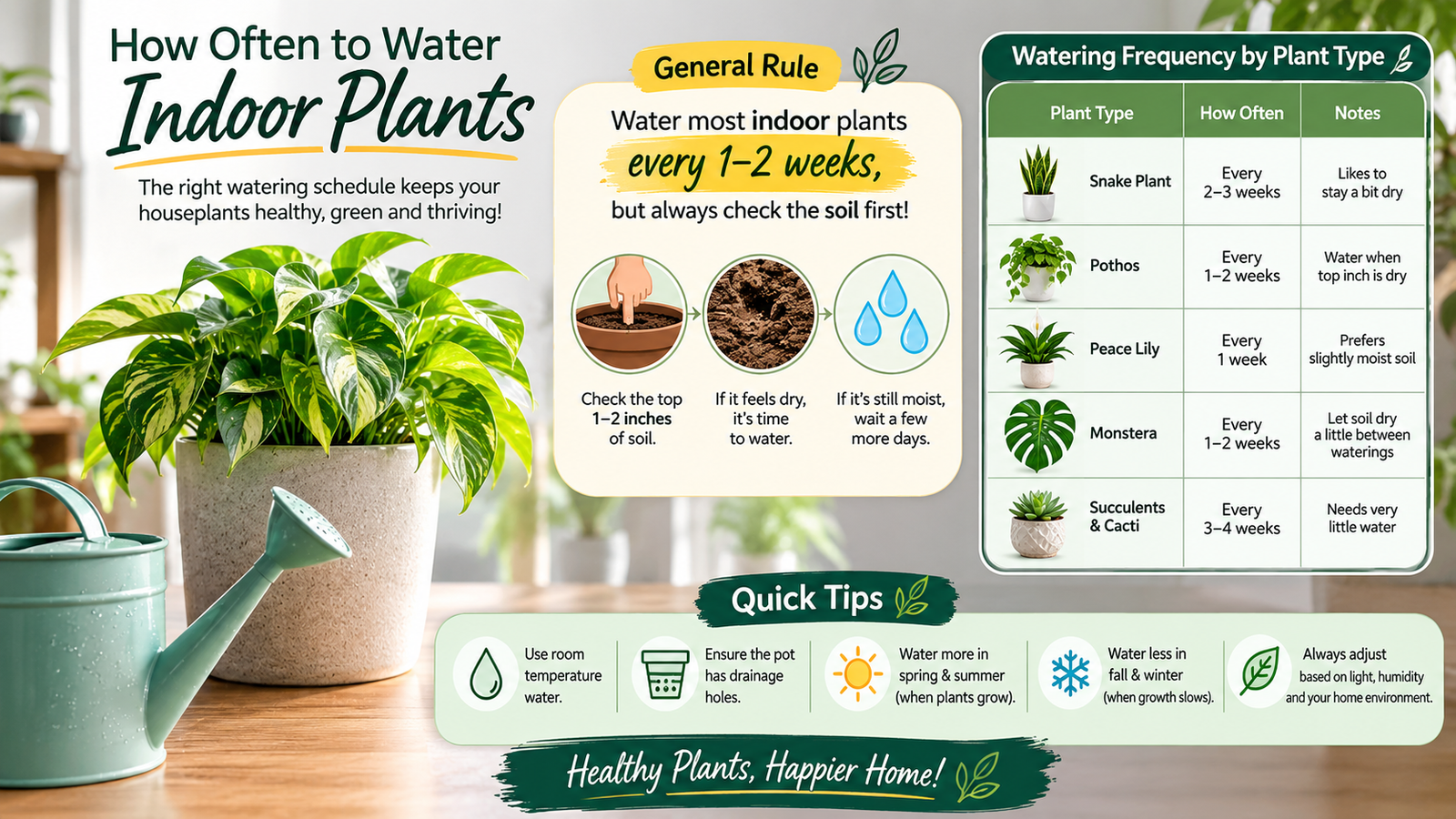
Knowing how often to water indoor plants can feel confusing, especially when one plant looks perfectly healthy while another develops yellow leaves after the same watering routine. The truth is that there is no single watering schedule that works for every houseplant.
For most indoor plants, the best approach is to check the soil and consider the plant’s individual moisture needs before watering. Factors such as light, temperature, humidity, pot size, soil type, and season can all change how often to water indoor plants.
Instead of watering every plant on the same day each week, use a simple routine: check the soil, understand your plant, water thoroughly when needed, and allow excess water to drain.
How Often Should You Water Indoor Plants?
If you’re wondering how often to water indoor plants, a good starting point is to check them about once a week. However, checking weekly does not mean watering weekly.
Some tropical houseplants may need water every several days in a warm, bright room, while drought-tolerant plants may go several weeks between waterings. Your home environment plays a major role in determining how often to water indoor plants.
A simple rule is:
Check the soil first, then decide whether the plant needs water.
For many common houseplants, water when the upper portion of the soil has dried. Plants such as cacti, succulents, snake plants, and ZZ plants usually prefer more drying between waterings.
Quick Indoor Plant Watering Guide
| Plant Type | General Watering Pattern | Check Before Watering |
| Pothos | Moderate | Upper soil feels dry |
| Monstera | Moderate | Top portion has dried |
| Peace lily | More frequent | Soil begins drying |
| Spider plant | Moderate | Upper soil is dry |
| Snake plant | Infrequent | Soil is substantially dry |
| ZZ plant | Infrequent | Soil is mostly dry |
| Ferns | More frequent | Soil remains slightly moist |
| Succulents | Infrequent | Soil is mostly dry |
| Cactus | Very infrequent | Soil is completely dry |
These are starting guidelines rather than strict schedules. The right how often to water indoor plants routine depends on the conditions surrounding each plant.
How to Tell When an Indoor Plant Needs Water
Learning the signs is more reliable than memorizing how often to water indoor plants.
Use the Finger Test
Insert your finger into the soil and feel for moisture. Checking only the surface can be misleading because the top layer may feel dry while deeper soil is still wet.
For many houseplants, checking roughly 1–2 inches below the surface provides a useful indication. However, succulents and cacti often need the soil to dry much more thoroughly.
This simple test can dramatically improve how often to water indoor plants because you are responding to actual soil conditions.
Lift the Pot
Pot weight is another useful clue.
A container filled with moist soil feels noticeably heavier than one that has dried out. After a few watering cycles, you can learn the normal weight of your plant before and after watering.
Use a Moisture Meter
A moisture meter can help beginners who have difficulty judging soil moisture by touch. It can be particularly useful for large containers where the surface doesn’t accurately represent moisture deeper in the pot.
However, don’t rely on a meter alone. Plant type and soil composition still matter when deciding how often to water indoor plants.
How Much Water Do Indoor Plants Need?
Knowing how often to water indoor plants is only half the equation. You also need to understand how much water to apply.
When a plant actually needs watering, water thoroughly enough to moisten the root zone. If the container has drainage holes, allow excess water to escape from the bottom.
Avoid giving a plant a tiny splash every day. Frequent shallow watering can leave some roots dry while keeping the surface constantly damp.
After watering, empty excess water from a saucer or decorative container. Standing water can keep roots saturated for too long.
The goal isn’t simply to use a specific number of cups. The amount depends on container size, soil, root mass, and plant requirements.
How Often to Water Different Indoor Plants
Different plants have different moisture preferences, so how often to water indoor plants should always be adjusted according to species.
Pothos
Pothos generally prefers moderate moisture. Let the upper portion of the soil dry before watering again.
Peace Lily
Peace lilies usually appreciate more consistent moisture than drought-tolerant plants. Don’t allow the soil to remain bone dry for extended periods.
Snake Plant
Snake plants store water and are much more tolerant of dry soil. Wait until the soil has dried considerably before watering.
ZZ Plant
ZZ plants also tolerate dry conditions well. Overwatering is generally a bigger concern than waiting a little longer.
Ferns
Many ferns prefer more consistent moisture. Their soil may need checking more frequently, particularly in warm or dry rooms.
Succulents and Cacti
These plants generally need substantial drying between waterings. Their thick leaves and stems store water, so watering too frequently can cause serious problems.
This is why asking only how often to water indoor plants without considering plant type can lead to mistakes.
What Affects How Often Indoor Plants Need Water?
Several environmental factors determine how often to water indoor plants.
Light
Plants receiving bright light often use water faster than plants kept in low-light locations.
For example, a pothos beside a bright window may dry much faster than an identical pothos several feet away from a dim window.
Temperature
Warm conditions can increase water use and cause soil to dry faster. A plant in a warm living room may therefore need checking more often than one in a cool room.
Humidity
Dry indoor air can increase moisture loss, while humid conditions may slow drying.
Air conditioning and heating can also change the humidity around plants.
Pot Size
Small pots generally dry faster because they contain less soil.
Large pots can hold moisture for considerably longer. This is one reason you should never copy another person’s watering schedule without considering your own container.
Pot Material
Terracotta pots are porous and can lose moisture through their sides. Plastic containers generally retain moisture longer.
Therefore, two plants with the same species and soil can still have different answers to how often to water indoor plants.
Soil Type
Fast-draining potting mixes dry faster than heavy mixes that retain moisture.
A well-draining indoor plant mix can help prevent water from remaining around roots for too long.
Airflow
Fans, open windows, heaters, and air-conditioning vents can influence drying speed.
If your plant sits directly beside an HVAC vent, check its soil rather than assuming your usual watering schedule still applies.
How Often to Water Indoor Plants in Winter
Many people ask how often to water indoor plants in winter because houseplants often behave differently during colder months.
In winter, many plants receive less sunlight and grow more slowly. As a result, the soil may remain wet longer.
That doesn’t mean every plant should automatically receive less water.
For example, a plant sitting near a sunny window in a heated room may still dry relatively quickly. The better approach is to monitor soil moisture.
When deciding how often to water indoor plants in winter, check:
- Light levels
- Room temperature
- Humidity
- Plant growth
- Soil moisture
- Pot size
- Plant type
Your winter routine should be based on what is happening to the plant rather than the calendar.
How Often to Water Indoor Plants in Summer
Summer can change how often to water indoor plants because brighter light and warmer temperatures may increase water use.
Plants near sunny windows may dry faster, particularly if the room becomes hot or dry.
However, don’t automatically double your watering frequency.
Check the soil first. If it remains moist, wait.
If it dries quickly, increase how frequently you inspect the plant.
This approach works better than following a fixed summertime schedule.
Overwatering vs. Underwatering
One of the biggest mistakes beginners make is assuming every drooping plant needs more water.
Unfortunately, both overwatering and underwatering can cause similar symptoms.
| Sign | Possible Underwatering | Possible Overwatering |
| Soil | Very dry | Stays wet |
| Leaves | Crispy or drooping | Yellow or drooping |
| Pot | Very light | Remains heavy |
| Roots | Dry | Brown or mushy |
| Soil smell | Normal | May become unpleasant |
| Response | May improve after watering | Can worsen with more water |
This is why how often to water indoor plants should never be determined by leaf appearance alone.
Always check the soil and consider the plant’s growing conditions.
How to Water Indoor Plants Without Overwatering
If you want to learn how to water indoor plants without overwatering, focus on consistency and observation.
First, check the soil.
Second, identify the plant’s moisture preference.
Third, water thoroughly when the soil has reached the appropriate level of dryness.
Fourth, make sure excess water can escape.
Finally, remove standing water from the saucer.
The most important principle is simple:
Don’t water a plant simply because it has been seven days. Water it because the plant and soil indicate that it needs water.
Top Watering vs. Bottom Watering
Both methods can work when used correctly.
Top Watering
Pour water onto the soil around the plant until the root zone is thoroughly moistened and excess water drains away.
This is the easiest method for most houseplants.
Bottom Watering
Place the nursery pot in a container of water and allow moisture to move upward through the drainage holes.
Bottom watering can be useful when very dry soil has become difficult to wet evenly.
Regardless of the method, the objective is healthy root-zone moisture—not keeping the soil permanently saturated.
Common Indoor Plant Watering Mistakes
Avoid these mistakes when deciding how often to water indoor plants:
Watering Every Sunday
A weekly check is useful, but weekly watering is not appropriate for every plant.
Watering Every Day
Most indoor plants don’t need daily watering. Constantly wet soil can deprive roots of oxygen.
Treating Every Plant the Same
A cactus, fern, pothos, and snake plant have different moisture preferences.
Ignoring Drainage
A decorative pot without drainage can trap excess water around the roots.
Giving Tiny Amounts
Small daily splashes can create inconsistent moisture. Water thoroughly when appropriate instead.
Ignoring Seasonal Changes
Plant growth, light, and room conditions change throughout the year, which can change how often to water indoor plants.
How to Build Your Own Indoor Plant Watering Routine
Rather than creating a strict calendar, create a checking routine.
Start by grouping your plants:
Group 1: Moisture-loving plants
Check frequently and avoid allowing the soil to become excessively dry.
Group 2: Moderate-water plants
Check the upper soil and water when it dries to the appropriate depth.
Group 3: Drought-tolerant plants
Allow substantially more drying before watering.
Instead of writing “water every Monday,” write:
“Check plants every Monday.”
Then water only the plants that actually need it.
Keep a simple record of when you water, how dry the soil was, and how quickly it dried afterward. After several weeks, you’ll begin to understand how often to water indoor plants in your particular home.
Real-Life Examples
Example 1: Pothos in Bright Light
A pothos placed beside a bright window in a warm room may dry quickly.
Check its soil regularly. If the upper soil dries sooner than expected, it may need watering more frequently.
Example 2: Snake Plant in Low Light
A snake plant in a low-light bedroom may use water slowly.
Even if a week has passed, check the soil before watering.
Example 3: Fern in a Dry Room
A fern near heating or air conditioning may lose moisture faster.
Monitor its soil more closely instead of using the same schedule as your snake plant.
Example 4: Succulent in Winter
A succulent receiving limited winter light may remain dry for a long time.
Don’t water simply because your other houseplants are due for attention.
These examples show why how often to water indoor plants is really a question about the plant plus its environment.
What to Do If You Overwatered an Indoor Plant
If the soil stays wet for an unusually long time, stop adding water and investigate the cause.
Check whether:
- The container has drainage holes.
- The saucer contains standing water.
- The soil is excessively compacted.
- The pot is much larger than the root system.
- The plant is receiving very little light.
If the plant shows serious decline, inspect the roots when appropriate. Healthy roots are generally firm, while severely damaged roots may be soft or mushy.
Don’t immediately resume watering because the leaves look wilted. Determine whether the root zone is actually dry first.
How to Water Indoor Plants While You’re Away
For a short trip, many established houseplants can manage without special equipment, depending on their species and current conditions.
Before leaving, check the soil rather than automatically soaking every plant.
Move plants away from intense direct sunlight if appropriate, but don’t place them in complete darkness.
For longer vacations, consider:
- A trusted plant sitter
- Self-watering systems
- Capillary watering methods
- Grouping plants according to water needs
Avoid creating a permanently saturated environment just because you’re leaving town.
Conclusion
Understanding how often to water indoor plants becomes much easier when you stop treating watering as a fixed calendar task.
Check the soil, learn your plant’s moisture preference, consider light and temperature, and pay attention to pot size, humidity, soil, and season. Water thoroughly when the plant needs it and allow excess water to drain.
The best routine is simple: check first, water second, and adjust based on what your plant tells you.
FAQs About How Often to Water Indoor Plants
1. How often should you water indoor plants?
There is no universal schedule. Many common houseplants may need checking around once a week, but actual watering depends on plant type, soil moisture, light, temperature, humidity, and pot size.
2. Is watering indoor plants once a week enough?
Sometimes, but not always. A weekly check is a better routine than automatic weekly watering. Some plants dry faster, while others can remain moist for several weeks.
3. Can I water indoor plants every day?
Usually, no. Daily watering can keep the soil excessively wet for many indoor plants. Always check the soil and the plant’s moisture requirements first.
4. How do I know when my indoor plant needs water?
Check the soil moisture, pot weight, and plant type. Don’t rely on leaf drooping alone because both underwatering and overwatering can cause wilting.
5. How often should I water indoor plants in winter?
Many plants need less frequent watering in winter because growth and light levels often decrease. However, heated rooms and sunny windows can change the situation, so check the soil before watering.
6. How often should I water indoor plants in summer?
Plants may need more frequent checking during summer because warmer temperatures and stronger light can dry soil faster. Still, water according to soil moisture rather than a fixed summer schedule.
7. How can I water indoor plants without overwatering?
Check the soil before watering, use a well-draining container, water thoroughly when needed, and allow excess water to drain away. Avoid watering simply because a certain number of days has passed.
You May Also Read: Best Herbs to Grow on a Balcony
