
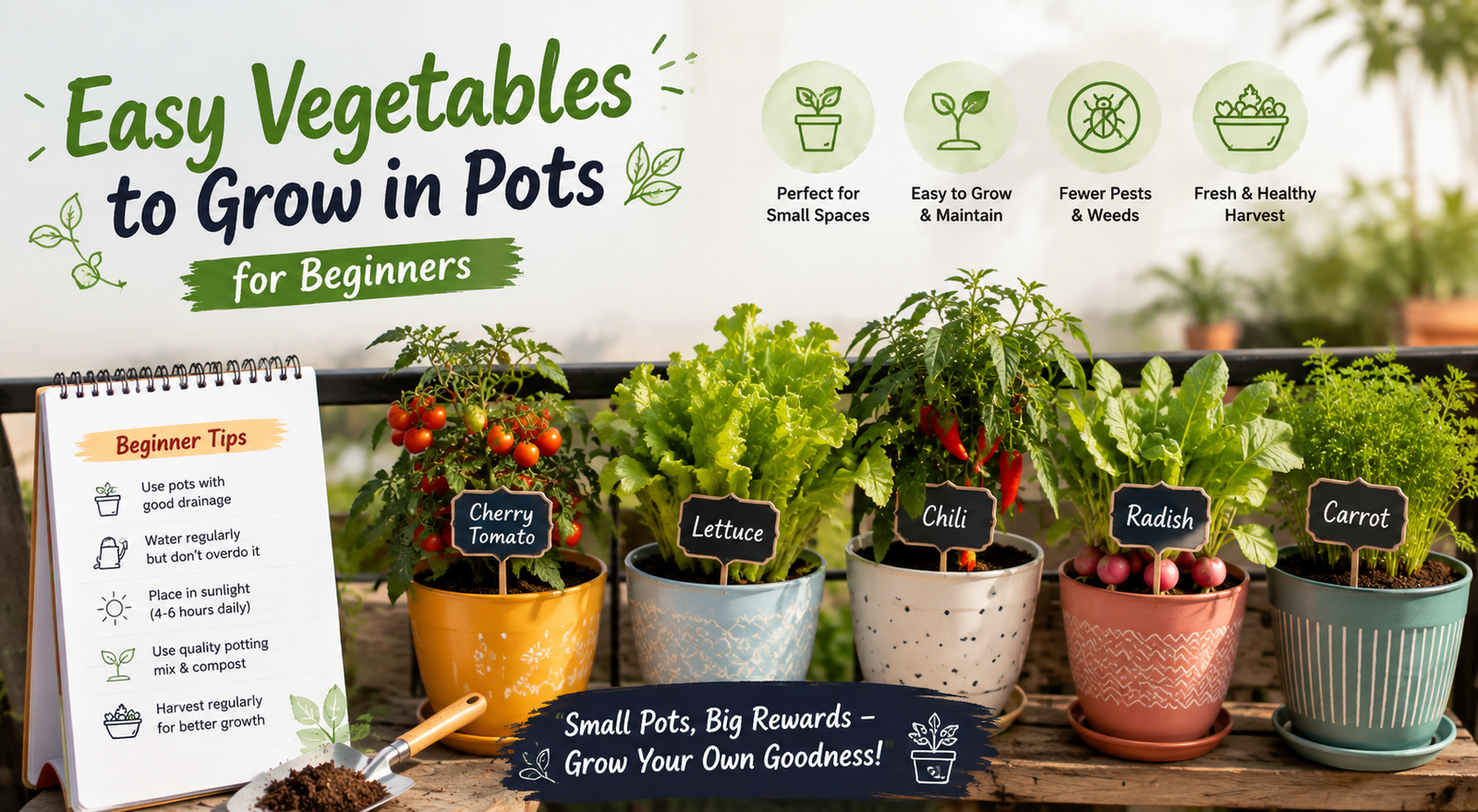
You don’t need a large backyard to enjoy fresh easy Vegetables to Grow in Pots for Beginners. A sunny balcony, patio, porch, windowsill, or even a few containers near your doorstep can become a productive mini garden. The key is choosing crops that match your available space, sunlight, pot size, and gardening experience.
If you’re new to container gardening, starting with the easy vegetables to grow in pots for beginners can make the entire process less intimidating. Crops such as lettuce, radishes, green onions, spinach, bush beans, and cherry tomatoes can provide satisfying results without requiring a traditional garden bed.
Growing vegetables in pots for beginners is also a practical way to learn how plants respond to water, sunlight, soil, and temperature. Once you understand the basics, you can gradually experiment with more demanding crops.
The best easy vegetables to grow in pots for beginners aren’t necessarily the vegetables that grow fastest. They are crops that can handle container conditions, don’t require complicated equipment, and give you a reasonable chance of getting a useful harvest.
What Makes a Vegetable Easy to Grow in a Pot?
Before choosing from a list of easy vegetables to grow in pots for beginners, it helps to understand what makes a crop suitable for containers.
First, look for compact or dwarf varieties. Large plants can quickly outgrow a small pot, while bush and patio varieties are easier to manage.
Root requirements also matter. Lettuce and radishes don’t need the same depth as carrots or potatoes. Choosing the correct container can make a noticeable difference.
Another factor is harvest time. Fast-growing easy Vegetables to Grow in Pots for Beginners provide beginners with visible progress, which makes them especially rewarding.
Finally, consider how forgiving the vegetable is. Some crops tolerate occasional watering mistakes, while others perform poorly when their soil becomes too dry or consistently waterlogged.
15 Easy Vegetables to Grow in Pots for Beginners
The following crops are among the most useful easy vegetables to grow in pots for beginners. Your results will still depend on variety, climate, sunlight, container size, and proper care.
| Vegetable | Suggested Pot | Light | Difficulty | Approx. Harvest |
| Lettuce | 6–8 inches deep | Partial to full sun | Very easy | 30–60 days |
| Radishes | 6–8 inches deep | Full/partial sun | Very easy | 20–40 days |
| Green onions | 6–8 inches | Partial/full sun | Very easy | 50–60 days |
| Spinach | 6–8 inches | Partial/full sun | Very easy | 30–50 days |
| Bush beans | 10–12 inches | Full sun | Easy | 50–65 days |
| Cherry tomatoes | 5+ gallons | Full sun | Easy | 55–80+ days |
| Peppers | 3–5 gallons | Full sun | Easy | 60–90+ days |
| Carrots | 10–12 inches deep | Full sun | Easy | 60–80+ days |
| Swiss chard | 8–12 inches | Partial/full sun | Easy | 50–60 days |
| Kale | 8–12 inches | Partial/full sun | Easy | 50–70 days |
| Potatoes | Deep container | Full sun | Easy | 70–120 days |
| Beets | 10–12 inches | Full sun | Easy | 50–70 days |
| Cucumbers | 5+ gallons | Full sun | Moderate | 50–70 days |
| Eggplant | 5+ gallons | Full sun | Moderate | 60–90+ days |
| Peas | 8–12 inches | Full/partial sun | Easy | 50–70 days |
1. Lettuce
Lettuce is one of the easiest vegetables for new container gardeners. It has a relatively shallow root system, grows well in modest containers, and can be harvested leaf by leaf.
Loose-leaf varieties are particularly useful because you don’t have to wait for an entire head to mature. Pick the outer leaves while allowing the center to continue growing.
For easy vegetables to grow in pots for beginners, lettuce is an excellent starting point for balconies and small patios.
2. Radishes
Radishes are ideal if you want quick results. They can be grown directly from seed and generally don’t require a large container.
Choose a pot deep enough for the variety you’re growing and use loose, well-draining potting mix. Avoid overcrowding because cramped roots can produce poorly formed radishes.
Among easy vegetables to grow in pots for beginners, radishes are especially rewarding because you can often see results within a relatively short growing period.
3. Green Onions
Green onions require little space and can thrive in relatively small containers. They are useful for gardeners who have only a balcony, windowsill, or narrow patio.
You can grow them from seed, sets, or suitable transplants. Harvest the outer portions gradually instead of removing every plant at once.
For anyone exploring easy vegetables to grow in pots for beginners, green onions are a simple crop that doesn’t demand much room.
4. Spinach
Spinach works particularly well in containers because it doesn’t need an enormous root system. It prefers cooler conditions, making it a useful crop for appropriate seasons.
Keep the potting mix reasonably moist and harvest young leaves when they’re ready. In warmer conditions, providing some afternoon protection can help.
Spinach belongs on any shortlist of easy vegetables to grow in pots for beginners, especially for gardeners with limited space.
5. Bush Beans
Bush beans are easier to manage in containers than many sprawling climbing varieties. They produce useful harvests from relatively compact plants.
Choose a container with sufficient depth and place it somewhere that receives plenty of sunlight. Regular harvesting encourages continued production.
If you’re selecting easy vegetables to grow in pots for beginners, bush beans offer an excellent balance between simple care and rewarding harvests.
6. Cherry Tomatoes
Cherry tomatoes are popular with beginners because even a small plant can produce a satisfying number of fruits.
The most important consideration is choosing an appropriate variety. Look for patio, dwarf, or determinate types when space is limited. Use a large container and provide a cage, stake, or other support.
Tomatoes need consistent moisture and plenty of sunlight. With the right setup, they are among the most enjoyable easy vegetables to grow in pots for beginners.
7. Peppers
Peppers adapt well to containers when they receive enough warmth and sunlight. Compact varieties are particularly suitable for patios and balconies.
Choose a sturdy pot, use quality potting mix, and avoid allowing the container to repeatedly dry out completely.
For easy vegetables to grow in pots for beginners, peppers are a good choice for gardeners who want a productive plant without needing a very large garden.
8. Carrots
Carrots can be grown in pots, but container depth is critical. Choose a deep container and a loose growing medium that allows the roots to develop without hitting compacted soil.
Short or round carrot varieties are often easier for containers than very long varieties.
Carrots are therefore good easy vegetables to grow in pots for beginners as long as you provide enough root space.
9. Swiss Chard
Swiss chard is attractive, productive, and relatively adaptable. Its colorful stems can also make a container garden more visually interesting.
Harvest the outside leaves first and allow the center of the plant to continue developing.
If you’re looking for easy vegetables to grow in pots for beginners that provide a long harvesting period, Swiss chard is worth considering.
10. Kale
Kale is another useful container crop, particularly during cooler growing periods. It doesn’t require the same amount of space as many fruiting vegetables.
Place the container somewhere with suitable sunlight and harvest the outer leaves as needed.
Kale can be a dependable choice among easy vegetables to grow in pots for beginners, particularly when growing conditions suit leafy greens.
11. Potatoes
Potatoes may seem unusual for containers, but they can perform well in deep pots or suitable grow bags.
The container needs good drainage and enough room for the developing roots and tubers. Some growing methods involve gradually adding growing medium as the plant develops.
For gardeners interested in easy vegetables to grow in pots for beginners, potatoes are a fun option because harvesting them can be surprisingly satisfying.
12. Beets
Beets offer two potential harvests: the roots and the edible young greens. They need enough depth for the developing root and reasonably consistent moisture.
Thin seedlings if necessary so individual plants have room to develop.
Beets are another practical addition to a list of easy vegetables to grow in pots for beginners.
13. Cucumbers
Cucumbers can grow successfully in containers, but they’re somewhat more demanding than radishes or lettuce. Choose compact or bush varieties and give the plant enough support.
A trellis can help keep the vines organized and save floor space. Consistent watering is particularly important during active growth.
For easy vegetables to grow in pots for beginners, cucumbers are best considered an intermediate choice when you have adequate space and sunlight.
14. Eggplant
Eggplant needs warmth, sunlight, and a reasonably large container. Compact varieties are preferable when growing in pots.
Although eggplant requires more attention than leafy greens, it can still be a manageable crop when grown under suitable conditions.
It can be included among easy vegetables to grow in pots for beginners for gardeners who want to move beyond the simplest crops.
15. Peas
Peas are useful container crops, particularly during suitable cooler growing periods. Give them enough soil depth and provide a small trellis or support for climbing varieties.
Regular harvesting can help you enjoy the crop while the plant continues producing.
Peas round out this selection of easy vegetables to grow in pots for beginners and are particularly useful when you want to make vertical use of limited space.
Best Vegetables for Small Pots
Not every vegetable requires a huge container. If you’re working with small pots, choose crops with relatively modest root requirements.
Good choices include:
- Lettuce
- Radishes
- Green onions
- Spinach
- Baby greens
- Some short-rooted carrots
These are some of the best easy vegetables to grow in pots for beginners when space is limited.
A simple rule is to match the container to the mature root system rather than choosing a pot based only on how large the plant looks above the soil.
Best Vegetables for a Sunny Balcony
A sunny balcony can be surprisingly productive. If your space receives several hours of direct sunlight, consider cherry tomatoes, peppers, bush beans, cucumbers, carrots, and eggplant.
Fruit-producing vegetables generally need more sunlight than leafy greens. Watch the balcony throughout the day before deciding what to plant.
For beginners growing vegetables in pots for beginners, placing the sun-loving crops in the brightest available position can make the difference between weak growth and healthy production.
Best Vegetables for Partial Shade
Not every growing space receives full sun. If your balcony or patio gets less direct sunlight, don’t give up.
Try:
- Lettuce
- Spinach
- Kale
- Swiss chard
- Radishes
- Green onions
These can be better choices than tomatoes or eggplant when sunlight is limited.
Among easy vegetables to grow in pots for beginners, leafy crops are often the most practical option for less-sunny locations.
Fastest Vegetables to Harvest in Pots
If you want quick results, prioritize crops with short maturity periods.
Radishes are one of the obvious choices, while baby lettuce, young spinach, green onions, and other leafy greens can also provide relatively quick harvests.
Fast-growing crops are excellent easy vegetables to grow in pots for beginners because they let you learn the basics without waiting an entire season to see whether your approach worked.
Remember that harvest times vary according to variety, temperature, sunlight, soil conditions, and planting date.
How to Choose the Right Pot
Choosing the right container is one of the most important parts of growing vegetables in pots for beginners.
Consider root depth
Lettuce can manage with a shallower container, while carrots and potatoes need substantially more depth.
Check for drainage
Every vegetable container should have adequate drainage. Excess water that cannot escape can create serious root problems.
Don’t overcrowd
A large container doesn’t automatically mean you can plant dozens of vegetables in it. Plants need enough room for roots, leaves, air circulation, and nutrients.
Think about weight
Large ceramic containers can become extremely heavy after being filled with soil and watered. Lightweight plastic or fabric containers may be easier for balconies and movable gardens.
What Soil Should You Use?
A quality potting mix is generally a better choice than ordinary garden soil for containers. Garden soil can become heavy and compacted when placed in a pot.
A good container mix should provide a balance of drainage, moisture retention, aeration, and nutrients.
This is especially important for easy vegetables to grow in pots for beginners, because suitable growing media reduce some of the problems associated with poor drainage and compacted roots.
How Often Should You Water Vegetables in Pots?
There is no universal watering schedule that works for every container.
Small pots can dry faster than large ones. Hot weather, wind, direct sunlight, plant size, and container material can also change how quickly moisture disappears.
Instead of watering automatically every day, check the growing medium. If it has started to dry and the crop needs moisture, water thoroughly enough to moisten the root zone while allowing excess water to drain.
Both overwatering and severe underwatering can cause problems. Learning to check your containers is one of the most valuable skills when growing vegetables in pots for beginners.
8 Common Mistakes Beginners Make
Even the easiest crops can struggle when basic container requirements are ignored.
1. Choosing a pot that’s too small
Restricted roots can limit plant growth and increase how quickly the container dries out.
2. Using heavy garden soil
Compacted soil can interfere with drainage and root development.
3. Forgetting drainage holes
Water needs a way to escape.
4. Planting too many vegetables
Crowded plants compete for light, water, nutrients, and space.
5. Ignoring sunlight
A tomato in deep shade won’t perform like a tomato receiving adequate sunlight.
6. Choosing oversized varieties
A full-size plant can overwhelm a small container. Compact varieties are usually easier to manage.
7. Watering on autopilot
A fixed schedule doesn’t account for weather and container conditions.
8. Forgetting support
Tomatoes, cucumbers, peas, and some beans may need stakes, cages, or trellises.
Avoiding these mistakes makes easy vegetables to grow in pots for beginners much easier to manage.
A Simple Beginner Container Garden Plan
If you’re unsure where to start, don’t plant 15 different crops immediately.
For a small balcony, try three containers:
Container 1: Lettuce and green onions
Container 2: Radishes
Container 3: One compact cherry tomato
For a larger sunny patio, add a pepper plant and bush beans.
This simple setup gives you a mixture of quick-growing leafy crops and longer-season vegetables. It also makes it easier to learn how each plant responds to water and sunlight.
A small, manageable collection of easy vegetables to grow in pots for beginners is usually better than creating a huge garden that becomes difficult to maintain.
How to Get Bigger Harvests From Small Containers
Once you’ve mastered the basics, you can improve productivity without adding dozens of pots.
Choose compact, productive varieties and harvest leafy vegetables regularly. For quick crops such as radishes and lettuce, succession planting can provide multiple harvests.
Vertical growing can also save valuable floor space. A suitable trellis allows peas or cucumbers to grow upward instead of spreading across the ground.
Consistent watering, adequate sunlight, appropriate feeding, and correct spacing also help plants make better use of the container.
These techniques can turn a few easy vegetables to grow in pots for beginners into a surprisingly productive small-space garden.
When Should You Plant Vegetables in Pots?
The best planting time depends on your local climate and the vegetable you’re growing.
Cool-season vegetables such as spinach, peas, lettuce, and some kale varieties generally prefer cooler conditions. Warm-season crops such as tomatoes, peppers, cucumbers, and eggplant need warmer conditions.
Check the seed packet or local gardening recommendations for planting dates instead of relying on one universal calendar.
Container soil can warm up and cool down more quickly than soil in the ground, so weather conditions deserve extra attention when growing vegetables in pots for beginners.
Conclusion
You don’t need years of gardening experience to grow fresh vegetables in containers. Start with a few forgiving crops, choose pots that provide enough root space, use a quality potting mix, and pay attention to sunlight and moisture.
Lettuce, radishes, green onions, spinach, bush beans, cherry tomatoes, peppers, carrots, kale, and Swiss chard are particularly useful starting points. Once you’re comfortable with these easy vegetables to grow in pots for beginners, you can experiment with potatoes, cucumbers, peas, and eggplant.
The goal isn’t to create a perfect garden on your first attempt. Start small, observe your plants, learn from mistakes, and expand as your confidence grows.
FAQs
What is the easiest vegetable to grow in a pot?
Radishes, lettuce, green onions, and spinach are excellent choices for first-time gardeners because they can grow in relatively small containers and don’t require complicated setups.
What vegetables grow well in 5-gallon pots?
Five-gallon containers can work well for crops such as compact tomatoes, peppers, bush beans, cucumbers, and some varieties of eggplant. Always check the mature size and root requirements of the specific variety.
Can I grow vegetables in pots on a balcony?
Yes. Balconies can be productive growing spaces when they receive suitable sunlight and the structure can safely support the weight of containers, soil, and water.
What vegetables grow best in small pots?
Lettuce, radishes, green onions, spinach, and some baby greens are good choices for smaller containers. Root crops should be selected according to the depth available.
How often should I water vegetables grown in pots?
Watering frequency depends on container size, weather, plant maturity, sunlight, and potting mix. Check the moisture of the growing medium instead of following a rigid daily schedule.
Do vegetables need full sun to grow in pots?
Not all vegetables need identical amounts of sunlight. Fruiting crops such as tomatoes and peppers generally need plenty of direct light, while many leafy greens can tolerate less.
Can I use garden soil in vegetable pots?
A suitable potting mix is generally preferable because it is designed for container conditions. Ordinary garden soil can become dense and restrict drainage and root development.
What are the fastest vegetables to grow in containers?
Radishes are among the quickest options. Lettuce, baby greens, spinach, and green onions can also provide relatively early harvests depending on variety and growing conditions.
You May Also Read: Best Plants for North-Facing Windows
