


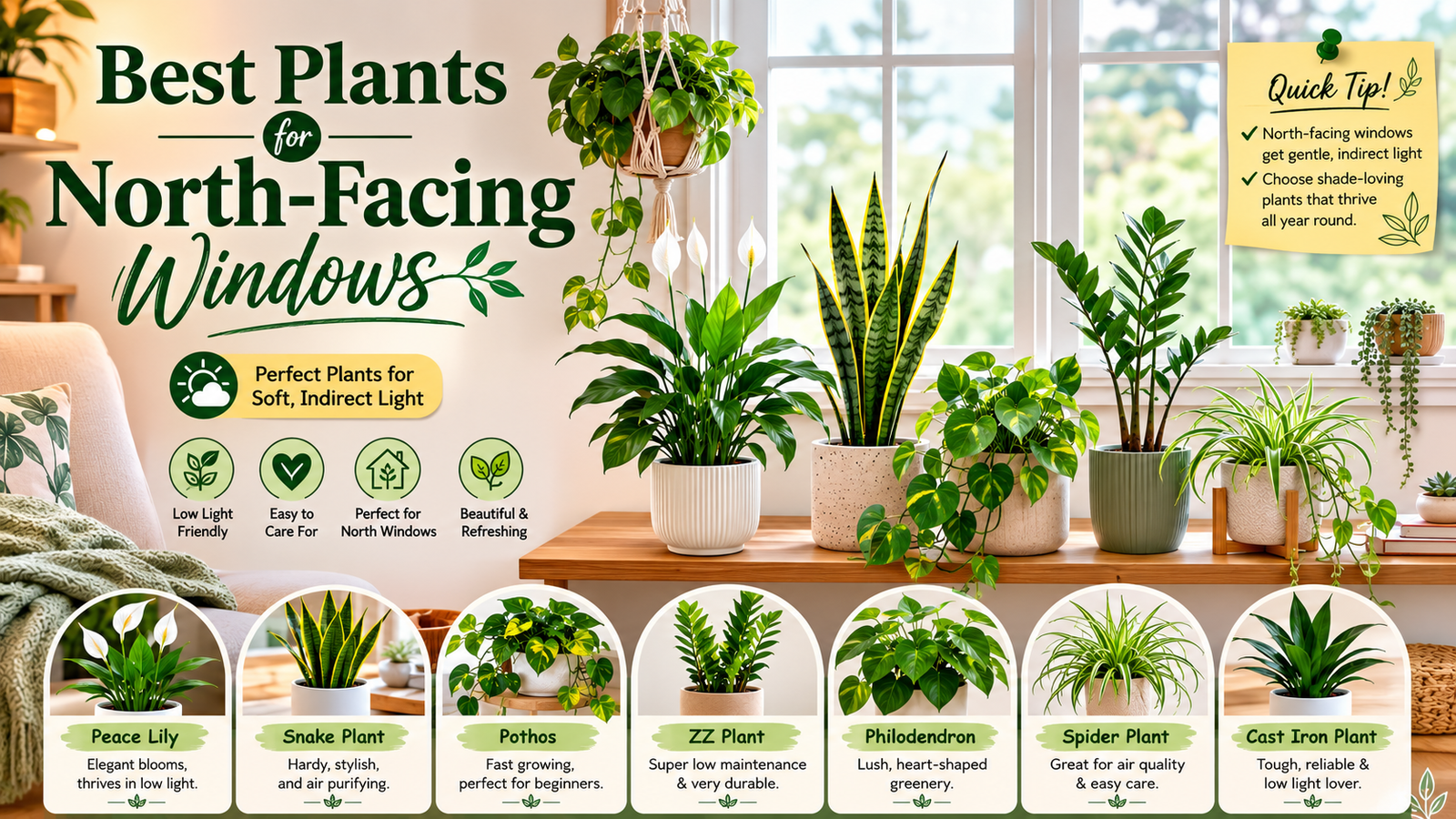
A north-facing window can seem like a difficult place for houseplants, especially when a room feels noticeably darker than one with a south- or west-facing window. The good news is that plenty of indoor plants can grow well in softer, indirect light. The key is choosing plants that match the amount of light your particular window actually provides.
The best plants for north-facing windows are generally shade-tolerant or low-light-adaptable varieties that do not demand several hours of strong direct sunlight. Snake plants, ZZ plants, pothos, cast iron plants, spider plants, and Chinese evergreens are some of the most reliable choices.
However, there is an important distinction: low light does not mean no light. A plant still needs enough usable light to photosynthesize and produce healthy new growth. Window size, outdoor obstructions, curtains, distance from the glass, and the season can all change the growing conditions.
In this guide, we’ll look at the best plants for north-facing windows, how to choose the right one for your room, how to care for it, and what to do when natural light is simply too weak.
What Makes a North-Facing Window Different?
In the Northern Hemisphere, a north-facing window typically receives less direct sunlight than windows facing south, east, or west. Instead, the room tends to receive softer, indirect natural light.
That makes north-facing exposure useful for foliage best Plants for North-Facing Windows that dislike intense sunlight. It can also reduce the risk of leaf scorch caused by strong direct rays.
However, not every north-facing window provides exactly the same amount of light. A large unobstructed window can be considerably brighter than a small window surrounded by buildings or shaded by trees.
For this reason, the best plants for north-facing windows are selected according to the actual conditions rather than the window direction alone.
How to Identify Your Light Conditions
Look at the area around your window during the brightest part of the day.
If the room is comfortably bright but direct sunlight rarely falls across the floor, you probably have a suitable environment for many low-light houseplants. If the area remains gloomy even during daylight hours, choose especially tolerant best Plants for North-Facing Windows or consider supplemental lighting.
Distance matters too. A plant sitting directly beside the window receives much more useful light than the same plant placed several feet into the room.
Quick Comparison of the Best Plants for North-Facing Windows
| Plant | Best For | Light Tolerance | Water Needs | Difficulty | Pet Safety* |
| Snake Plant | Overall choice | Very low–medium | Low | Easy | Check before purchase |
| ZZ Plant | Beginners | Very low–medium | Low | Very easy | Not pet-safe |
| Pothos | Trailing growth | Low–medium | Moderate | Easy | Not pet-safe |
| Cast Iron Plant | Very low light | Very low | Low–moderate | Easy | Generally considered pet-friendly |
| Spider Plant | Hanging baskets | Low–medium | Moderate | Easy | Generally pet-friendly |
| Chinese Evergreen | Decorative foliage | Low–medium | Moderate | Easy | Not pet-safe |
| Peace Lily | Flowers | Low–medium | Moderate | Medium | Not pet-safe |
| Parlor Palm | Floor display | Low–medium | Moderate | Easy | Generally pet-friendly |
| Heartleaf Philodendron | Trailing vines | Low–medium | Moderate | Easy | Not pet-safe |
| Boston Fern | Humid rooms | Low–medium | Higher | Medium | Generally pet-friendly |
*Always verify plant toxicity for your specific species or cultivar before bringing it into a home with pets or children.
15 Best Plants for North-Facing Windows
1. Snake Plant — Best Overall
Snake plants are among the easiest choices for lower-light rooms. Their upright leaves take up little horizontal space, making them useful for shelves, corners, and narrow window areas.
They also tolerate periods of dryness better than many tropical houseplants. The biggest mistake is usually watering too frequently. Allow the growing medium to dry appropriately before watering again.
For someone searching for the best plants for north-facing windows with minimal maintenance, a snake plant is an excellent starting point.
2. ZZ Plant — Best for Beginners
ZZ plants are another excellent option for people who occasionally forget to water their best Plants for North-Facing Windows. Their thick stems and underground rhizomes allow them to handle dry periods.
Place a ZZ plant near the brightest part of your north-facing window without expecting rapid growth. In very dim conditions, growth may be slow, but the plant can remain attractive with relatively little attention.
3. Pothos — Best Trailing Plant
Pothos is ideal when you want greenery that spills over a shelf or hangs from a planter. It adapts to a range of indoor conditions and is particularly popular because it is easy to propagate.
A north-facing window can work well for pothos, although strongly variegated varieties may show less contrast when light is insufficient.
If you’re looking for best plants for north-facing windows that also provide a trailing effect, pothos deserves a place near the top of the list.
4. Cast Iron Plant — Best for Very Low Light
The cast iron plant has earned its reputation for being exceptionally forgiving. It handles shade better than many common houseplants and is a particularly useful choice for rooms where sunlight is limited.
Its growth is relatively slow, so don’t expect it to suddenly fill a room. Instead, think of it as a dependable foliage plant that can handle conditions that would challenge more demanding varieties.
For heavily shaded rooms, it is one of the best plants for north-facing windows to consider.
5. Chinese Evergreen — Best Decorative Foliage
Chinese evergreen, or Aglaonema, offers attractive foliage in several patterns and shades. Many varieties tolerate lower light, although brighter conditions may help maintain stronger coloration in some cultivars.
Keep the soil moderately moist but avoid leaving the roots sitting in stagnant water. Good drainage is essential.
6. Peace Lily — Best Flowering Option
Peace lilies are popular because they combine attractive foliage with white flowers. They can tolerate lower light, but extremely dark conditions may reduce flowering.
One useful feature is their tendency to droop noticeably when they become thirsty. However, repeated severe wilting isn’t ideal, so use soil moisture as your main watering guide.
They are a good choice when you want one of the best plants for north-facing windows that can add a flowering element to the room.
7. Spider Plant — Best Hanging Plant
Spider plants work beautifully in hanging baskets, on shelves, or near a bright north-facing window. Mature best Plants for North-Facing Windows can produce long stems with small plantlets, giving them a fuller appearance over time.
They are also relatively easy to propagate. Allow the soil to partially dry between waterings and avoid keeping the pot constantly saturated.
8. Parlor Palm — Best Tropical Look
If you want a softer, tropical appearance, consider a parlor palm. It generally prefers bright, indirect light but can adapt to lower-light indoor spaces.
A north-facing window can provide a gentler environment than a hot, sunny exposure. Keep an eye on watering and humidity, particularly if the room has very dry air.
9. Heartleaf Philodendron — Best Easy-Care Vine
Heartleaf philodendron is another useful trailing plant. Its heart-shaped leaves and flexible growth make it suitable for shelves, hanging planters, and plant stands.
Low light may slow its growth and make the stems more stretched out. If you notice unusually long spaces between leaves, move it closer to the window or increase supplemental lighting.
10. Boston Fern — Best for Humid Rooms
Boston ferns can work near north-facing windows when humidity and moisture are adequate. They are especially attractive in bathrooms or other naturally humid areas.
Unlike snake plants and ZZ plants, ferns generally do not appreciate being allowed to become extremely dry for long periods. They need a more consistent moisture routine and good air circulation.
11. Prayer Plant — Best Patterned Foliage
Prayer plants are prized for their colorful, patterned leaves. They prefer indirect light and can be damaged by harsh direct sunlight.
A north-facing window can provide a suitable starting point, especially when the room is bright enough. Keep humidity reasonably consistent and avoid letting the soil remain either bone-dry or waterlogged for extended periods.
12. Fittonia — Best Small Windowsill Plant
Fittonia is a compact option for people with limited space. Its colorful leaf veins can add visual interest without requiring a large planter.
These are particularly useful small plants for north-facing window spaces because they can sit comfortably on a narrow sill or shelf.
Keep the growing medium lightly and consistently moist while ensuring excess water can drain away.
13. African Violet — Best Compact Flowering Plant
African violets are small enough for windowsills and can produce attractive flowers when their growing conditions are right.
They generally prefer bright, indirect light rather than intense direct sunlight. If your north-facing window is particularly dim, flowering may become less reliable, so monitor the plant’s growth carefully.
14. Prayer Plant or Calathea — Best for Decorative Leaves
Calatheas are attractive choices when foliage is the main priority. Their patterned leaves can make a north-facing room feel more vibrant.
However, they are less forgiving than snake plants or ZZ plants. They can react poorly to inconsistent moisture, very dry air, or unsuitable light.
Choose them when you’re willing to provide a little more attention rather than simply wanting the toughest plant available.
15. Aglaonema — Best for Easy Foliage
Aglaonema varieties are widely used as low-light indoor plants because many tolerate conditions that are unsuitable for sun-loving species.
They are available in numerous foliage patterns, making it possible to choose a variety that fits your interior style. In very dim locations, expect slower growth and potentially less vibrant coloration.
Best Plants by Your Specific Need
Choosing among the best plants for north-facing windows becomes easier when you start with your actual situation.
Best for Complete Beginners
Choose a snake plant, ZZ plant, or cast iron plant if your priority is easy maintenance.
These plants are generally more forgiving of missed waterings and slower-growing conditions than thirstier or more sensitive varieties.
Best for Small Spaces
For small plants for north-facing window placement, Fittonia, African violet, and compact snake plants are practical choices.
Use a pot that fits the sill without blocking the window or creating a tipping hazard.
Best for Large Displays
If you’re searching for large indoor plants for north-facing window areas, consider a parlor palm, larger snake plant, or a suitable mature foliage plant.
Remember that large size does not automatically mean high-light requirements. Match the species to the available light before choosing a floor plant.
Best Trailing Plants
Pothos and heartleaf philodendron are strong choices for hanging baskets and shelves. Spider plants are another option when you want cascading foliage with the bonus of producing plantlets.
Best for Flowering
Peace lilies and African violets can provide flowers, but don’t expect heavy blooming in an extremely dark room.
Flower production generally requires more usable light than simply keeping foliage alive.
What If Your North-Facing Window Is Obstructed?
An obstructed window deserves special attention. Trees, neighboring buildings, balconies, privacy screens, or thick curtains can reduce the amount of light reaching your plants.
In this situation, some of the best plants for north-facing windows may still struggle if there is very little usable daylight.
Try moving the plant as close to the window as practical. Keep the glass clean and remove unnecessary barriers such as heavy curtains during daylight hours.
For example, imagine a pothos sitting directly beside a large, unobstructed north-facing window. It may perform reasonably well. Move that same plant several feet into a dark corner behind curtains, and its growth could become noticeably weaker.
How to Tell If Your Plant Needs More Light
Your plant can tell you a lot through its growth.
Watch for:
- Long, stretched stems
- Small new leaves
- Slow or stalled growth
- Leaning strongly toward the window
- Loss of variegation
- Reduced flowering
- Unusual leaf drop
Leggy growth is particularly useful evidence. If new stems become thin and widely spaced, the plant may be trying to reach a stronger light source.
When this happens, first try moving the plant closer to the window. If that doesn’t solve the problem, supplemental lighting may be worthwhile.
How to Care for Plants in a North-Facing Window
Even the best plants for north-facing windows can struggle when basic care is incorrect.
Water According to the Soil
Don’t automatically water every Sunday. Check the soil first.
Lower light can mean slower growth and slower water use. If you continue watering on a fixed schedule, the pot may remain wet for too long, increasing the risk of root problems.
Use Containers With Drainage
A drainage hole allows excess water to escape. Decorative cachepots are fine, but don’t let the inner pot sit permanently in collected water.
Rotate Plants When Necessary
If growth consistently leans toward the window, gently rotate the pot periodically. This can help maintain a more balanced shape.
Clean Dusty Leaves
Dust can accumulate on foliage, particularly near windows. Gently wiping broad leaves can keep them cleaner and improve their appearance.
Adjust Care Seasonally
Winter often brings shorter daylight hours and slower plant growth. You may need to reduce watering frequency rather than continuing the same routine you used during brighter months.
When Should You Use a Grow Light?
A grow light can be useful when a north-facing window is exceptionally dim or obstructed.
Consider supplemental lighting if your plant repeatedly develops weak, stretched growth despite being placed close to the glass.
LED grow lights are a practical option for home use. A timer can also make the routine easier because the plant receives a consistent lighting period.
You don’t necessarily need an elaborate setup. For one or two best Plants for North-Facing Windows, a small suitable LED grow light positioned according to the manufacturer’s instructions may be enough.
Plants That Usually Don’t Belong in a North-Facing Window
Not every houseplant belongs in low-light conditions.
Many cacti, succulents, citrus plants, and other high-light species generally perform better with substantially brighter exposure. They may survive temporarily in a dim north-facing location, but survival is not the same as healthy growth.
If you already own a high-light plant, don’t automatically discard it. Consider moving it to a brighter east-, south-, or west-facing location, or provide appropriate supplemental lighting.
Common Mistakes to Avoid
The biggest mistake is assuming that a low-light plant can live in complete darkness.
Another common problem is overwatering. Because plants may grow more slowly in reduced light, they often don’t use water as quickly.
Avoid placing best Plants for North-Facing Windows far from the window without checking whether enough light reaches them. Also, don’t assume every north-facing window is equally bright.
Finally, be realistic about growth speed. A plant that tolerates low light may grow more slowly than the same species placed in brighter indirect light.
Conclusion
Choosing the right plant is less about finding a magical “low-light plant” and more about matching the plant to your actual indoor conditions. A bright, unobstructed north-facing window can support many attractive foliage plants, while a heavily shaded window may require a more tolerant species or supplemental lighting.
For beginners, snake plants, ZZ plants, pothos, and cast iron plants are excellent starting points. If you want flowers, consider peace lilies or African violets. For shelves and hanging baskets, pothos, heartleaf philodendron, and spider plants provide attractive trailing growth.
The best plants for north-facing windows are ultimately the ones that match your light level, watering habits, available space, and desired appearance. Start with a tolerant plant, observe its growth, and adjust its position if the signs suggest it needs more light.
Frequently Asked Questions
What are the best plants for north-facing windows?
Some of the strongest options include snake plants, ZZ plants, pothos, cast iron plants, Chinese evergreens, spider plants, peace lilies, parlor palms, and heartleaf philodendrons. The right choice depends on the actual brightness and whether the window is obstructed.
Are north-facing windows good for houseplants?
Yes. They can be excellent for plants that prefer lower or indirect light. The important factor is that the room still provides enough usable natural light for the chosen species.
What are the best plants for a very dark north-facing window?
Cast iron plants, snake plants, ZZ plants, and some Aglaonema varieties are worth considering. If the room is genuinely dark, however, even tolerant plants may benefit from a grow light.
What are the best small plants for north-facing window spaces?
Fittonia and African violets are compact options, while smaller snake plants can also work well. Choose containers that fit securely on the sill and don’t obstruct the window.
Can flowering plants grow in a north-facing window?
Some can, including peace lilies and African violets. However, flowering generally requires more usable light than simply maintaining foliage, so extremely dim conditions may reduce blooms.
Do plants in a north-facing window need a grow light?
Not always. If the window provides adequate indirect light and the plant is growing normally, additional lighting may not be necessary. A grow light becomes more useful when growth is consistently weak or the window is heavily obstructed.
How often should I water plants in a north-facing window?
There is no universal schedule. Check the soil and the individual plant’s requirements before watering. Reduced light can slow water use, so watering too frequently can create persistently wet soil.
You May Also Read: How to Revive a Dying Plant
